How to Mix Old and New Decor Without It Looking Cluttered
Mixing heirloom finds with sleek modern pieces can make a home feel layered, personal, and sophisticated, if we do it right. Too often, blending old and new decor ends up chaotic: clashing finishes, competing scales, and crowded surfaces. In this guide we’ll walk through a practical, room-by-room approach that helps you combine eras with intention. You’ll learn planning strategies, proportion rules, styling techniques, and budget-friendly restoration tips so our spaces feel curated rather than cluttered.
Why Blending Old And New Works—And What Causes Clutter
Blending old and new decor works because contrasting pieces create visual interest and tell a story: an antique chest anchors family history while a contemporary lamp keeps things fresh. That interplay of narrative and novelty can make a room feel lived-in and designed all at once.
But clutter creeps in when we mix without rules. The common culprits are:
- Too many competing finishes: brass, chrome, and walnut fighting for attention.
- Mismatched scale: several oversized items competing in the same sightline.
- Unedited surfaces: every ledge crowded with small objects and curios.
- No unifying palette or texture strategy: colors and materials that don’t talk to each other.
Understanding why these issues happen helps us avoid them. We want contrast, yes, but contrast that’s intentional. Think of the room as a playlist: a few memorable tracks (major pieces) and supporting tones (accents and textures). When we curate with that mindset, the result reads as deliberate rather than accidental.
Create A Unified Plan Before You Start
Before we haul vintage finds into a room, we make a plan. A simple, consistent strategy reduces second-guessing and prevents clutter.
Establish A Cohesive Color And Material Palette
Choose 3–5 main colors: a dominant neutral, a secondary neutral, and 1–2 accent colors. Pull those colors from existing pieces (a rug, a textile, or a painting) to ensure the palette feels rooted. Matching materials is as important as color: if we have warm wood tones in an antique sideboard, we’ll introduce other warm elements, leather, warm metals, or woven fibers, rather than lots of cool chrome.
Choose One Dominant Finish And Two Supporting Accents
Pick a dominant finish (for example, aged brass or matte black) that appears on large or primary pieces. Then choose one or two supporting accents to repeat in smaller doses. Repetition creates cohesion: a brass lamp, a brass picture frame, and brass cabinet hardware will read like an intentional thread rather than random flashes.
Use Texture To Add Depth Without Visual Noise
Texture can make a simple palette feel rich without adding visual clutter. We layer a chunky knit throw over a sleek sofa, or a handwoven rug beneath a modern coffee table. The idea is to vary tactile qualities, soft, rough, glossy, matte, while keeping color and scale controlled. That way, texture provides depth but doesn’t introduce competing visual patterns.
Balance Scale And Proportion Across Pieces
Scale and proportion are the backbone of a non-cluttered mix. When sizes harmonize, disparate styles can coexist.
Anchor Rooms With A Few Large, Calm Elements
We recommend starting with two or three large, calm elements per room: a sofa, a rug, and a major light fixture or console. These anchors set the room’s visual weight and mood, allowing us to add smaller vintage or modern pieces without chaos. A large, neutral sofa will calm visual noise, even if the side tables and accessories are eclectic.
Avoid Competing Small Objects, Edit Aggressively
Small objects can quickly compete and make surfaces feel messy. We edit ruthlessly: pick one or two groupings for a side table or mantel and leave the rest empty. If we love many small finds, we rotate them seasonally rather than layering them all at once.
Define Focal Points And Let Other Items Play Supportive Roles
Decide the room’s focal point, the fireplace, a large piece of art, or the view out a window, and let that dominate. Other elements should support by echoing color, finish, or scale. That hierarchy prevents every object from demanding attention at once and creates a calm, curated feeling.
Mix Styles Intentionally, Not Randomly
Intentional mixing means pairing pieces with shared visual language rather than just their ages. We ask: do these items share a line, shape, material, or mood?
Pair Pieces By Shared Lines, Shape, Or Era, Not Just Age
A mid-century sideboard and a contemporary credenza can look cohesive if they share horizontal lines and similar leg profiles. Likewise, an ornate vintage mirror can sit well above a modern console if they share complementary proportions. We prioritize visual relationships over historical accuracy.
Bridge Eras With Transitional Items And Repeats
Transitional pieces, those that sit between styles, like a modern sofa with tapered legs or a simple wooden coffee table with a hand-carved edge, act as bridges. Repeating elements (a recurring metal finish, repeated color, or recurring shape like circles or rectangles) also stitches different eras together.
Use Symmetry And Grouping To Create Order
Symmetry brings instant calm. Flanking a vintage sofa with matching modern lamps organizes the composition. For asymmetrical pairings, group items into clusters that read as a single unit, three vases on a console rather than ten scattered curios. Grouping creates breathing room and a sense of intentionality.
Layer Lighting And Art To Unify Diverse Pieces
Lighting and art are powerful unifiers: they set mood and visually connect disparate objects.
Create Visual Rhythm With Lighting Types And Heights
We layer ambient, task, and accent lighting. A central pendant (ambient), floor and table lamps (task), and picture lights or wall sconces (accent) create a rhythm of light that moves the eye. Vary heights, a low table lamp beside a tall floor lamp, to create depth. When the lighting finishes share a common finish or silhouette, they discreetly tie old and new together.
Frame And Place Art To Tie Old And New Together
Art placement matters. A single large artwork over a vintage chest will unify both: several smaller pieces grouped tightly can act like one large object. When mixing frames, we stick to a family of finishes (e.g., black frames with a single brass piece) or use consistent matting to harmonize diverse works. Art also allows us to pull accent colors across the room, reinforcing the palette and diminishing the sense of scattered styles.
Practical Styling Techniques To Avoid Cluttered Surfaces
Styling is where rooms live or look chaotic. These hands-on techniques keep surfaces intentional.
Edit Accessories: Less Is More, Use Odd Numbers And Negative Space
We choose three to five objects for a tabletop vignette and leave generous negative space. Odd numbers tend to feel more natural: three is a safe, aesthetically pleasing choice. When we assemble a grouping, we vary heights and materials to create a mini-composition rather than a pile of stuff.
Use Trays, Books, And Stands To Corral Smaller Items
Trays visually anchor and contain groups of objects, a tray on a coffee table keeps candles, a small bowl, and a remotes box from spreading. Stacking books provides height and purpose for smaller items, while a small pedestal or stand elevates a single object to feel intentional rather than lost.
Rotate Decor Seasonally To Keep Displays Fresh And Minimal
Rather than crowding every shelf with permanent displays, we rotate decor. Swap in lighter accessories and fewer pieces for spring and summer: transition to cozier textures in fall. Rotation reduces accumulated clutter and makes each display feel thoughtful. It also gives us an excuse to reassess what we truly love.
Room-By-Room Strategies And Examples
Different rooms demand different approaches. Here are practical examples we can carry out immediately.
Living Room: Mix Seating, Tables, And Shelves Thoughtfully
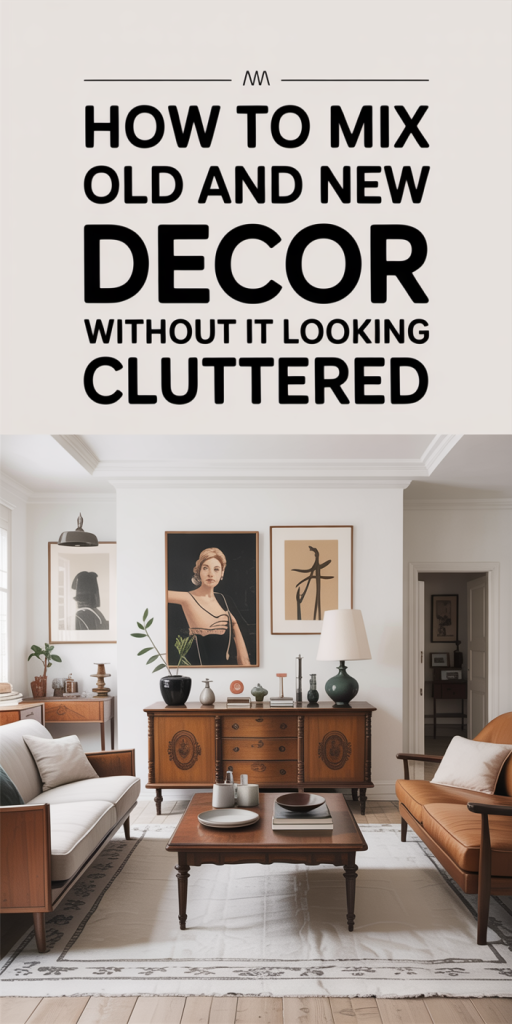
Start with a neutral, larger seating anchor and add one or two statement chairs, perhaps a vintage leather armchair paired with a modern sofa. Keep coffee and side tables in complementary sizes and finishes: if one table is ornate, let the other be minimal. On shelves, use repeating elements: a pair of ceramic vases, a stack of books in the room’s accent color, and a singular antique clock. Leave empty shelf space to avoid a museum-like crowdedness.
Dining Room: Balance A Vintage Table With Modern Lighting
A large vintage dining table is a beautiful anchor. Pair it with contemporary chairs in a repeated finish for a cohesive look. Above, choose modern lighting that echoes either the table’s scale or the chairs’ finish, an oversized pendant in matte black or a cluster of glass globes can feel deliberate. For the buffet or hutch, keep styling minimal: one architectural vase, a framed painting, and a functional tray for daily items.
Bedroom: Blend Antique Headboards With Contemporary Bedding And Hardware
An antique headboard becomes the dramatic focal point. Soften it with crisp, contemporary bedding in our chosen palette and streamlined bedside tables. Swap ornate hardware for simpler knobs if you want to modernize dressers, or keep a couple of antique accessories to honor the piece’s character. Nightstands should be uncluttered, a lamp, one book, and a small dish for essentials is often enough.
Where To Shop, Restore, And Update Pieces Affordably
Mixing old and new doesn’t have to be expensive. Knowing where to look and how to refresh pieces makes great design accessible.
Sourcing Tips: Thrift, Antique Markets, And Modern Finds
- Thrift stores and estate sales: great for unique finds at low cost. Go with measurements and a photo of the room’s palette in your phone.
- Antique markets and local dealers: pricier but often higher-quality, with pieces worth investing in.
- Online marketplaces: filter by dimensions and search terms (e.g., “mid-century sideboard”) to find what fits.
- Discount modern retailers and outlet stores: ideal for clean-lined, affordable anchors like sofas and lighting.
We recommend buying the largest pieces first (sofa, rug, table) and then hunting for complementary vintage accents.
Simple Restoration And Refresh Techniques (Paint, Reupholstery, Hardware)
Minor updates can modernize older pieces:
- Paint: A coat of chalk or milk paint on a dated dresser can transform it. Keep the paint color within your palette to ensure cohesion.
- Reupholstery: Updating fabric is often cheaper than buying new. Swap out worn upholstery for performance fabrics in neutral tones.
- Hardware: Replacing knobs and pulls with a chosen finish unifies hardware across eras.
- Minor repairs: Tightening joints, cleaning finishes, and waxing surfaces go a long way toward making an old piece feel cared-for rather than shabby.
These techniques extend the life of vintage finds and allow us to tailor them to our plan.
Common Mistakes To Avoid When Mixing Old And New
We’ve learned from projects that certain missteps repeat. Avoid these to keep the mix intentional.
Overmatching, Overaccessorizing, And Ignoring Functionality
- Overmatching: Trying to make everything match perfectly removes personality. Aim for harmony, not uniformity.
- Overaccessorizing: Too many small pieces make surfaces noisy. Edit down and prioritize negative space.
- Ignoring functionality: A beautiful chair that’s uncomfortable or a fragile coffee table that can’t take daily use is a design compromise. We balance aesthetics with liveability.
When To Call A Pro: Scale, Structural Changes, Or Complex Restores
Call a professional when: you’re changing room scale (moving walls, changing window sizes), dealing with structural restoration of antiques (complex joinery or veneer repairs), or when lighting and electrical changes require a licensed electrician. A pro helps avoid costly mistakes and will ensure safety and longevity.
Conclusion
Mixing old and new decor without it looking cluttered comes down to intention: a cohesive palette, controlled scale, purposeful grouping, and smart editing. We don’t need to own fewer things: we just need to place them with purpose. Start with anchors, repeat finishes and colors, edit small objects, and rotate deliberately. With those principles, our homes can feel layered and personal, not chaotic. Now, pick one room, identify your anchors, and try a single change: swap a lamp, edit a shelf, or repaint a vintage find. Small, intentional steps lead to a curated whole.