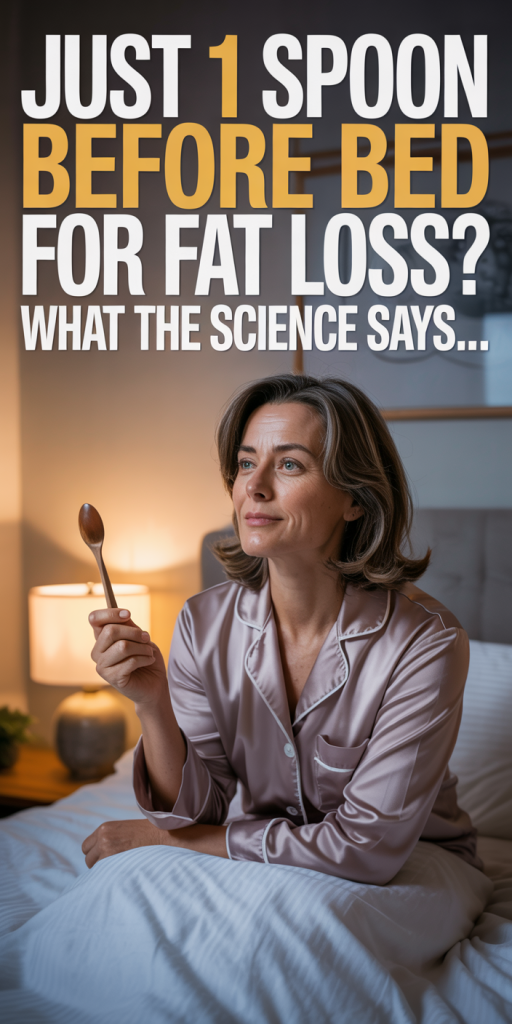
Just 1 Spoon Before Bed for Fat Loss? Here’s the Truth
Scroll through social media for five minutes and you’ll see it.
“Take one spoon before bed and melt fat overnight.”
It sounds easy. Effortless. Almost magical.
Usually it’s a mix of honey, cinnamon, apple cider vinegar, or chia seeds. No workouts. No diet overhaul. Just a spoonful before bed and you wake up leaner.
But does that actually work?
Let’s separate science from hype — and talk about what truly drives nighttime fat loss.
Why the “One Spoon” Idea Took Off
The promise is simple:
One natural ingredient. One bedtime ritual. Fat loss while you sleep.
That’s powerful marketing.
The ingredients are common and feel “healthy”:
- Honey
- Cinnamon
- Apple cider vinegar
- Chia seeds
The message? You don’t need discipline. You don’t need structure. You don’t need a calorie deficit. Just a spoon.
But the human body doesn’t work like that.
To understand why, we need to look at what actually happens while you sleep.
What Your Body Really Does at Night
When you fall asleep, your metabolism doesn’t shut off — but it does slow down.
Your metabolic rate drops about 10–15%. That’s normal. Your body shifts into repair mode:
- Muscle repair
- Hormone regulation
- Tissue recovery
- Brain detoxification
- Fat metabolism
You still burn calories through your basal metabolic rate (BMR) — keeping your heart beating, lungs breathing, and brain functioning.
Here’s where it gets interesting:
Sleep quality determines what your body burns.
In one controlled study, people sleeping 8.5 hours lost significantly more body fat than those sleeping 5.5 hours — and the short sleepers lost more muscle instead.
That’s huge.
Poor sleep doesn’t just slow fat loss. It changes what kind of weight you lose.
The Real Problem: Sleep Deprivation
If you’re not sleeping well, no bedtime hack will save you.
Lack of sleep:
- Raises ghrelin (hunger hormone)
- Lowers leptin (fullness hormone)
- Increases cravings
- Reduces insulin sensitivity
- Raises stress hormones
Just six nights of four hours of sleep can reduce glucose tolerance by around 40%.
That means your body handles sugar worse. Which means more fat storage potential.
Before worrying about a spoonful of anything, fix your sleep.
Now let’s look at the actual ingredients in these viral mixes.
Cinnamon: Does It Burn Fat?
Cinnamon gets a lot of attention — and for good reason.
Researchers at the University of Michigan found that cinnamaldehyde (a compound in cinnamon) can activate fat cells in lab settings. It increases thermogenesis — the process of burning stored energy as heat.
That sounds impressive.
But here’s the catch:
Those studies used concentrated extracts in controlled environments. The amount in a casual sprinkle at home is far lower.
So yes — cinnamon has metabolic potential.
No — a teaspoon before bed won’t melt fat overnight.
It’s supportive, not transformational.
Honey: Helpful or Just Sugar?
Honey shows some interesting results in animal studies:
- Improved hormonal profiles
- Increased adiponectin (fat-burning hormone)
- Reduced body fat in certain models
But human evidence is limited.
And let’s be honest:
One tablespoon of honey has about 64 calories.
It’s still sugar.
If you’re not in a calorie deficit, adding honey before bed won’t magically reduce fat.
Replacing processed dessert with a small amount of honey? Sure, that’s better.
But context matters.
Apple Cider Vinegar: The Social Media Favorite
Apple cider vinegar might be the most hyped of them all.
Some small studies suggest it may:
- Improve fullness
- Slightly reduce blood sugar spikes
- Help digestion for some people
But major medical institutions are clear:
It does not produce significant weight loss on its own.
At best, it’s mildly supportive.
At worst, it irritates your stomach.
Again — supplement, not solution.
So What Actually Works at Night?
Now we get to the part that matters.
If you want to enhance fat loss overnight, here’s what science consistently supports.
1. Prioritize Protein Before Bed
Protein is powerful at night.
It:
- Supports muscle repair
- Increases satiety
- Reduces late-night cravings
- Helps preserve lean mass during fat loss
Even better? Muscle tissue increases resting metabolism.
Options:
- Greek yogurt
- Cottage cheese
- Casein protein shake
Aim for 20–30 grams if you’re using it strategically.
This does more for fat loss than any spoon trend.
2. Add Fiber
Fiber stabilizes blood sugar.
It:
- Slows digestion
- Reduces insulin spikes
- Feeds gut bacteria
- Increases fullness
Good evening options:
- Chia seeds
- Berries
- Apple slices
- Hummus and vegetables
Stable blood sugar overnight supports better fat metabolism.
3. Optimize Your Sleep Environment
This is overlooked — but critical.
Your bedroom should be:
- Cool (around 65–68°F)
- Completely dark
- Screen-free before bed
- Consistent in schedule
Blue light suppresses melatonin.
Light disrupts sleep depth.
Poor sleep wrecks fat loss.
This matters more than any mixture.
4. Follow the 4-Hour Rule
Finish your main meal about 3–4 hours before bed.
Why?
Because digestion competes with recovery.
Allowing insulin levels to drop before sleep may help your body shift toward fat utilization overnight.
If you need a snack, keep it light and protein-focused.
5. The Non-Negotiable: Calorie Deficit
Here’s the foundational truth:
No bedtime ritual works without a calorie deficit.
Fat loss only happens when you consistently burn more energy than you consume over time.
It doesn’t matter if you eat at 7 PM or 10 PM.
It matters how much you eat overall.
Late-night weight gain is usually behavioral:
- Mindless snacking
- High-calorie choices
- Emotional eating
Fix daytime nutrition and most nighttime cravings disappear.
The Real Nighttime Fat Loss Formula
If we strip away the hype, the formula is simple:
- Eat adequate protein daily
- Include fiber
- Sleep 7–9 hours
- Keep your room cool and dark
- Maintain a calorie deficit
That’s it.
Boring? Maybe.
Effective? Absolutely.
Verdict: Is “1 Spoon Before Bed” a Scam?
Not entirely.
There’s a grain of truth:
- Cinnamon has metabolic properties
- Honey may have minor benefits
- Chia adds fiber
- Vinegar may help blood sugar slightly
But none of them override energy balance.
No spoon melts fat on its own.
It can support a healthy routine — especially if it replaces junk food.
But it cannot replace:
- Proper sleep
- Protein intake
- Calorie awareness
- Consistency
That’s the part social media skips.
A Better Bedtime Option
If you want something practical instead of hype, try this:
The Bedtime Protein Bowl
- 1 cup plain Greek yogurt
- ½ teaspoon cinnamon
- 1 tablespoon chia seeds
- ½ cup berries
You get:
- Slow-digesting casein protein
- Fiber
- Antioxidants
- Stable blood sugar
No crash. No spike. No gimmick.
What to Do Starting Tonight
Forget the magic spoon.
Instead:
- Close the kitchen 3–4 hours before bed
- Eat enough protein during the day
- Prioritize sleep
- Keep your room cool and dark
- Stay consistent
Small habits repeated nightly create real change.
Fat loss doesn’t happen because of one spoon.
It happens because of structured, repeatable behavior.
And that’s far more powerful than anything viral.
If you’re serious about sustainable fat loss, focus on sleep, protein, fiber, and consistency.
The magic isn’t in a spoon.
It’s in the system.