One-Pan Low-Carb Meals: 25 Quick Recipes And Cleanup Hacks For Busy Weeknights
We’re juggling work, family, and the endless cycle of dinner decisions, and the last thing we want is a sink full of pans. One-pan low-carb meals are the dinner shortcut that actually delivers: fewer dishes, faster prep, and meals that align with low-carb goals without sacrificing flavor. In this guide we’ll explain why one-pan low-carb meals work, what tools and pantry staples set us up for success, key techniques that elevate simple dishes, eight immediately actionable recipes (with templates and variations), and practical meal-planning plus cleanup hacks. By the end, you’ll have 25 meal ideas and a toolbox of habits to make weeknight cooking stress-free and sustainable.
Why One-Pan Low-Carb Meals Work — Health, Time, And Cleanup Benefits
One-pan low-carb meals work because they solve three persistent dinner problems at once: they make it easier to hit macro and micronutrient goals, reduce the time spent cooking, and eliminate the cleanup friction that kills our motivation to cook.
Health benefits
- Portion control and macro balance: One-pan meals force us to assemble protein, non-starchy vegetables, and healthy fats on a single surface, the simplest path to a balanced low-carb plate. When we combine leafy greens or cruciferous vegetables with a protein and a fat source, we naturally reduce reliance on starchy fillers.
- Nutrient retention: Cooking vegetables quickly in a covered pan or roasting them alongside protein preserves vitamins and minerals better than boiling. Searing proteins first also locks in flavor so we rely less on heavy sauces or added sugar.
- Blood-sugar stability: Low-carb one-pan dinners that include fiber and fat help blunt post-meal glucose spikes, which is helpful for metabolic health, weight control, and energy stability.
Time savings
- Consolidated steps: When we cook everything together, we streamline prep and active cook time. We’re no longer toggling between multiple burners or juggling timing for separate sides. Many one-pan dishes finish in 20–35 minutes.
- Faster cleanup: One pan typically means one wash, or, if we use foil or an ovenproof liner, sometimes zero immediate washing. That saves time and reduces the mental load that leads us to order takeout.
Cleanup and sustainability
- Fewer dishes = less water and detergent use. That small change adds up across weeks, lowering our kitchen’s environmental footprint.
- Less energy: We use one heat source more efficiently. Roasting one sheet or simmering one skillet often requires less energy than running multiple elements.
Psychology and habit
- Reduced friction encourages consistency. We celebrate small wins: a tasty, healthy meal without the dread of washing up. Those wins compound over time and make weeknight cooking a habit instead of a chore.
Putting these benefits together, one-pan low-carb meals are a high-ROI strategy: minimal time invested for consistent, nutritious outcomes and far less cleanup friction to derail our intent to eat at home.
Essential Tools, Cookware, And Pantry Staples For One-Pan Success
A few well-chosen tools and pantry staples dramatically increase our success rate with one-pan low-carb meals. We don’t need a kitchen full of gadgets, just the right versatile pieces.
Must-have cookware
- Heavy-bottomed skillet (10–12 inch, oven-safe): Our workhorse. A cast-iron or stainless-steel skillet gives even heat for searing and transfers to the oven for finishing.
- Sheet pan (rimmed, half-sheet): Ideal for roasting vegetables and proteins together: easy to line with parchment or foil for nearly effortless cleanup.
- Dutch oven (4–6 quart, optional): Great for one-pot stews and braises that are still low-carb when we use vegetables like cauliflower and mushrooms.
- Nonstick sauté pan: For delicate proteins (fish, eggs) where sticking is a concern.
Useful accessories
- Tongs, silicone spatula, and a fish spatula: For safe flipping and deglazing.
- Instant-read thermometer: Prevents overcooking protein, especially useful when we’re cooking multiple ingredients together.
- Foil, parchment paper, and silicone baking mats: They turn a messy pan into a disposable surface and cut cleanup time dramatically.
Pantry staples
These ingredients keep one-pan low-carb meals flavorful and flexible.
Proteins
- Boneless skin-on chicken thighs (cheaper, forgiving), salmon fillets, firm tofu, ground turkey/beef, shrimp.
Low-carb vegetables
- Cauliflower (rice, florets), zucchini, bell peppers, broccoli, Brussels sprouts, spinach, mushrooms, asparagus.
Fats and flavor carriers
- Olive oil, avocado oil, ghee, butter. These are our primary cooking fats and flavor vehicles.
Condiments and seasonings
- Dijon mustard, soy sauce or tamari (use sparingly for lower sodium), fish sauce (a little goes a long way), apple cider vinegar, lemon/lime, chili flakes, paprika, cumin, dried oregano, garlic powder, onion powder.
- Low-carb sweeteners (optional): erythritol or monk fruit for glazes when we want a touch of sweetness without carbs.
Convenience items
- Pre-riced cauliflower (fresh or frozen), jarred pesto, and low-sugar tomato sauce can speed up assembly. Frozen vegetables and proteins are great for last-minute dinners.
Storage and organization
- Airtight containers to store prepped vegetables and cooked components. If we prep weekday-ready bags, chopped peppers, cauli-rice, and marinated chicken, dinner practically cooks itself.
With these tools and staples on hand, we can improvise dozens of one-pan low-carb meals with confidence and minimal shopping stress.
Key Techniques For One-Pan Success
Getting great results from one-pan cooking depends less on recipes and more on a handful of reliable techniques. Master these and even improvised combos will taste intentional.
Searing, Browning, And Building Flavor
Searing is the foundation of flavor in one-pan dishes. When we sear proteins or vegetables until they brown, we create Maillard reactions, complex flavor compounds that taste roasted and savory.
- Heat: Preheat the pan until it’s hot but not smoking. For stainless steel or cast iron, wait until a few drops of water skitter across the surface.
- Fat: Use an appropriate amount of oil or clarified butter to coat the pan. Too little and things stick: too much and you lose browning.
- Don’t crowd: Give items space. Overcrowding traps steam and prevents browning. If we’re making a larger batch, we sear in two batches and finish together in the oven.
- Deglaze: After searing, deglaze with a splash of stock, wine, vinegar, or even water. Deglazing dissolves the browned bits and becomes the base of a pan sauce that ties the dish together.
Why it matters: Searing and deglazing create depth so we don’t rely on added sugar or heavy sauces for flavor, perfect for low-carb cooking.
Layering Ingredients And Timing For Even Cooking
One-pan success is mostly about rhythm: which ingredient goes in when.
- Hard vegetables first: Start with vegetables that take longest to cook (carrots, Brussels sprouts, broccoli stems, raw cauliflower florets). Roast or sear them first so they develop color and tenderness.
- Medium vegetables next: Peppers, onions, mushrooms, and summer squash join after the hard vegetables have had a head start.
- Proteins at the right moment: For meats that benefit from searing and finishing in the oven (chicken thighs, pork chops), start with a sear and then add back to the pan with vegetables for a finish. For delicate proteins (fish, shrimp), add them toward the end so they don’t overcook.
- Leafy greens last: Add spinach or arugula in the final 1–2 minutes so they wilt but stay bright.
- Sauces and finishing touches: Add acid (lemon, vinegar) and fresh herbs at the end to brighten flavors and restore contrast.
Timing tips we use
- Cut uniformly: Smaller, uniform pieces cook at the same rate.
- Use residual heat: When the oven is turned off, resting a covered pan for a few minutes lets carryover heat finish proteins gently.
- One-pan roasting strategy: If we roast everything on a sheet pan, place thicker items (bone-in chicken, root vegetables) at the hotter parts of the pan and smaller items toward the center.
Mastering these techniques gives us predictably great results and makes improvisation less risky: we can combine any protein and veg and know roughly how to schedule their entry into the pan for balanced texture and doneness.
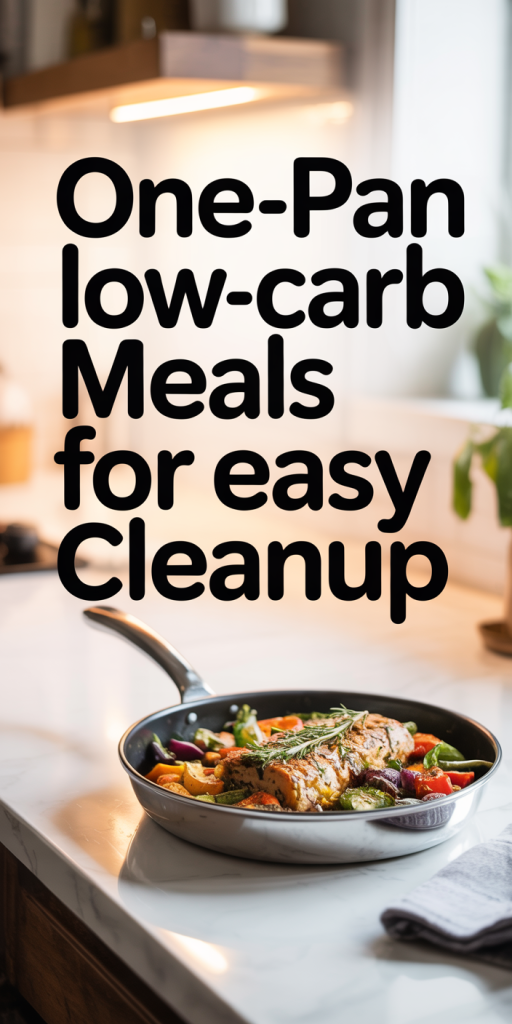
8 One-Pan Low-Carb Meal Ideas You Can Make Tonight (Templates + Variations)
Below are eight templates we can mix and match. Each template includes a basic method, a few variations, and quick timing so dinner is doable even on hectic nights. These templates easily generate our promised 25 meal ideas by swapping proteins, vegetables, or flavor profiles.
- Sheet-Pan Lemon Herb Chicken + Broccoli (20–30 minutes)
- Method: Toss bone-in or boneless chicken thighs with olive oil, lemon zest, garlic, salt, pepper, and thyme. Toss broccoli florets with oil, salt, and pepper. Arrange on a rimmed sheet pan, roast at 425°F for 20–25 minutes: broil 1–2 minutes if needed for browning.
- Variations: Swap chicken for salmon (roast 10–12 minutes) or tofu (press first, roast 15–20 minutes). Replace broccoli with Brussels sprouts or asparagus.
- Skillet Garlic Butter Salmon with Zucchini Ribbons (15–20 minutes)
- Method: Season salmon, sear skin-side down in a hot skillet until crispy, flip and baste with garlic butter. Add zucchini ribbons to the pan for 2–3 minutes until tender.
- Variations: Use trout or chicken cutlets: swap zucchini for thin-sliced summer squash or bok choy.
- Cauliflower “Fried Rice” with Shrimp (15 minutes)
- Method: Sauté minced garlic and ginger, add riced cauliflower, cook until slightly golden, push to the side and quickly scramble eggs, combine, then add shrimp and a splash of tamari: finish with scallions and sesame oil.
- Variations: Use diced chicken or pork: add snow peas or shredded cabbage for extra crunch.
- One-Pan Mediterranean Beef Skillet (25–30 minutes)
- Method: Brown ground beef with onion, garlic, and oregano, drain excess fat, add diced tomatoes (low-sugar) and chopped spinach: simmer until wilted. Serve with crumbled feta and olives.
- Variations: Use lamb or turkey: add roasted eggplant or zucchini: swap feta for goat cheese.
- Sheet-Pan Pesto Salmon with Green Beans and Cherry Tomatoes (18–22 minutes)
- Method: Spread a thin layer of pesto on salmon fillets, toss green beans and tomatoes with olive oil, salt, and pepper, arrange and roast at 400°F until salmon is flaky.
- Variations: Use pesto-marinated chicken or halloumi. Replace green beans with asparagus.
- Skillet Pork Chops with Sautéed Apples & Cabbage (25 minutes)
- Method: Sear seasoned pork chops, remove, sauté shredded cabbage and thin apple slices in the same skillet until caramelized, deglaze with apple cider vinegar, return chops to finish in the pan.
- Variations: Swap pork for chicken thighs: skip apples and use roasted turnips for lower sugar.
- One-Pan Fajita Bowl (20 minutes)
- Method: Sear strips of steak or chicken with fajita seasoning, add sliced bell peppers and onions, cook until charred. Serve over cauliflower rice and top with avocado and lime.
- Variations: Use shrimp or tofu: try a smoky chipotle-lime marinade instead of classic fajita seasoning.
- Creamy Mushroom & Spinach Skillet with Poached Eggs (15–20 minutes)
- Method: Sauté mushrooms until golden, add garlic, finish with cream (or a lower-carb option: crème fraîche), stir in spinach until wilted, create wells and gently crack eggs, cover to poach.
- Variations: Add cooked diced ham or smoked salmon: use coconut cream for a dairy-free version.
How to expand to 25 meals quickly
- Swap proteins across the eight templates (e.g., chicken, salmon, tofu, shrimp, pork, ground turkey, steak, halloumi), that’s 8 x 8 = many permutations.
- Swap vegetables seasonally (broccoli, brussels, asparagus, cauliflower, zucchini, spinach, cabbage) to create fresh variations.
- Switch flavor profiles: Mediterranean, Asian, Mexican, Italian, and Middle Eastern seasonings turn the same technique into distinct dishes.
These templates are intentionally modular: once we’ve cooked a few, we’ll be able to assemble new one-pan low-carb meals without a recipe and with very little thinking.
Meal-Planning, Batch Cooking, And Cleanup Shortcuts
To make one-pan low-carb cooking truly effortless, we pair it with simple planning and cleanup habits. Here’s how we streamline the whole process from shopping to leftover storage.
Weekly planning ritual (15–20 minutes)
- Pick 3–4 templates: Choose several one-pan templates for the week and assign proteins/veggies. This reduces daily decision fatigue.
- Build a shopping list by category: proteins, vegetables, fats, spices. Buying for multiple recipes reduces waste and saves time.
- Prep day: If we have an hour, we can chop vegetables, marinate proteins, and portion cauli-rice into meal-sized bags. That halves evening prep.
Batch cooking and component prep
- Roast a large sheet pan of mixed vegetables: We can repurpose them across meals (wraps, salads, or reheated with a protein). Roasted veg keep well for 3–4 days.
- Cook proteins in bulk: Roast a tray of chicken thighs or bake salmon fillets to slice into salads and bowls during the week.
- Pre-riced cauliflower: Make a double batch of cauliflower rice and store it in shallow containers for quick reheats.
Make-ahead marinades and sauces
- Jarred dressings and marinades: Whisk olive oil with lemon, mustard, and herbs in a jar for quick tossing.
- Pesto, chimichurri, and tahini sauces are excellent finishers that brighten reheated dishes and require minimal fridge space.
Cleanup shortcuts
- Line pans: Use foil, parchment, or silicone mats to roast on. We often slide the liner into the trash and wipe the pan, no scrubbing.
- Soak immediately: If we skip a liner, we add a drop of dish soap and hot water to the pan while it cools to loosen stuck-on bits.
- One-pot cleanup routine: Rinse pan, fill with hot soapy water and a scrubber, then finish cleaning after dinner while we enjoy dessert or tidy counters.
- Dishwasher-safe strategy: When possible, use ovenproof baking dishes and silicone tools that go straight into the dishwasher.
Leftovers and reheating
- Reheating: Reheat in a skillet with a splash of water or oil to revive texture rather than microwaving, which can make proteins rubbery and vegetables soggy.
- Reinvention: Turn leftovers into new meals, roasted chicken becomes a low-carb chicken salad, and leftover veggies mix into an omelet or frittata.
Grocery and time-saving tips
- Frozen is fine: Keep frozen shrimp, riced cauliflower, and green beans on hand for last-minute meals.
- Buy family packs and portion: We save money and time by portioning larger cuts into meal-sized packages before freezing.
These planning and cleanup habits make one-pan low-carb meals not just a one-off convenience but a sustainable weekly practice.
Troubleshooting Common One-Pan Problems (Soggy Veg, Overcooked Protein, Sticking)
Even with good technique, issues happen. Here are practical fixes we use when a one-pan dinner goes sideways.
Problem: Soggy vegetables
- Cause: Overcrowding the pan or cooking at too low a temperature, which traps steam and prevents browning.
- Fixes: Spread vegetables in a single layer with space between pieces. Use higher heat (425°F for roasting) and consider two pans if we’re cooking a large amount. For stovetop, increase heat briefly to get color, then lower to finish.
Problem: Overcooked protein (dry chicken, rubbery shrimp)
- Cause: Proteins have different cook times and are often added at the wrong moment.
- Fixes: Use an instant-read thermometer (165°F for chicken, 145°F for most fish, 120–125°F for rare steak depending on cut). Add delicate proteins near the end of cooking. For chicken thighs, choose bone-in or skin-on for more forgiveness: dark meat tolerates longer cooking.
Problem: Sticking to the pan
- Cause: Insufficient preheating or not enough fat for stainless/cast iron pans.
- Fixes: Preheat properly and add oil just before the protein. For stainless steel, test with a small piece, if it sticks, let it build a crust: proteins release naturally once properly seared. Use nonstick for eggs or fish when needed. Deglaze hot pans to lift stuck bits.
Problem: Uneven cooking on a sheet pan
- Cause: Crowding, or placing thicker pieces and thin pieces on the same pan.
- Fixes: Group items by thickness. Put larger, denser pieces toward the hotter edges or on their own pan. Rotate the pan halfway through roasting for even color.
Problem: Burnt bottoms, raw tops
- Cause: Heat too high or relying solely on stovetop for large batches.
- Fixes: Finish in the oven to cook through evenly. If the top is raw but the bottom is burned, lower stove heat and cover the pan or move to the oven to finish gently.
Problem: Flavorless results
- Cause: Lack of seasoning layers.
- Fixes: Season in stages: salt early on vegetables to draw some moisture and build flavor: finish with acid (lemon, vinegar) and fresh herbs to add brightness. Use umami boosters, a splash of soy/tamari, fish sauce, or a sprinkle of nutritional yeast.
By diagnosing the cause and applying a targeted fix, we rescue dinners and learn for next time. Over time these troubleshooting steps become second nature and dramatically reduce waste and frustration.
Conclusion
One-pan low-carb meals give us a practical path to consistently eating well without sacrificing evenings to cleanup. They combine efficient techniques, searing for flavor, smart layering of ingredients, and modest planning, with a small set of reliable tools and pantry staples. Use the eight templates we shared as launching points: swap proteins, switch vegetables by season, and vary spices to multiply options quickly.
Let’s commit to a simple habit loop: pick a template, prep once, cook together, and clean with one motion (liner, soak, or wipe). The result is more than convenience: it’s freedom. We eat better, save time, and remove a recurring friction point that often pulls us toward takeout.
Try this challenge: pick three templates, shop for them on your next grocery run, and prep one evening’s components on Sunday. We’ll be surprised how much smoother weeknights become, and how many new favorite dinners we can create with just one pan and a little planning.