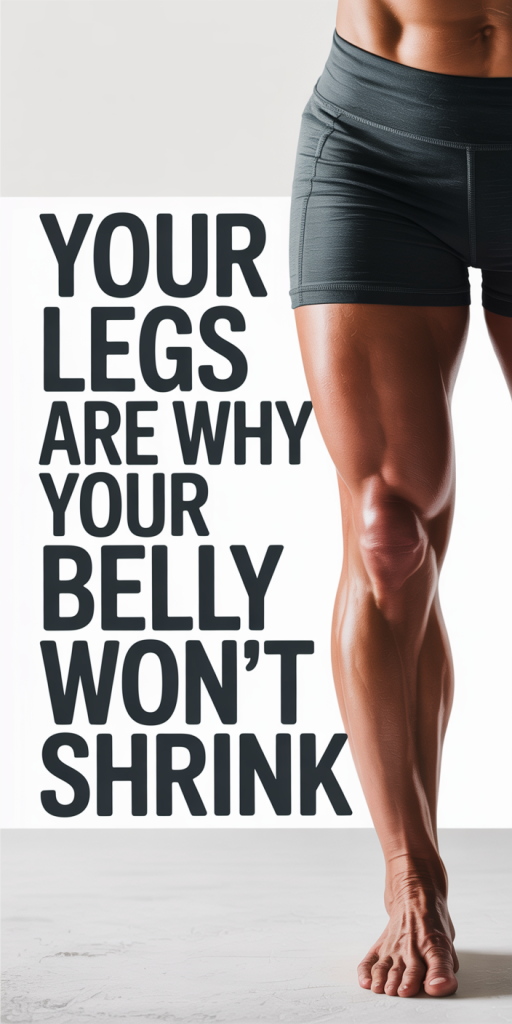
Your Legs Are Why Your Belly Won’t Shrink
You can do crunches until the sun goes down.
You can spend hours on the treadmill staring at the wall.
You can cut carbs, sugar, and every food you actually enjoy eating.
But if you are skipping heavy leg training, your belly fat may not be going anywhere.
That sounds dramatic, but there is a reason so many people spend months trying to flatten their stomach while completely ignoring the largest muscle groups in the body. Most people are focused on “fat-burning” workouts. The real secret is building a body that burns more energy all day long.
And that starts with your legs.
The Frustrating Truth About Belly Fat
A lot of women feel like they are doing everything right.
They’re eating salads.
They’re walking daily.
They’re doing cardio five times a week.
They’re knocking out ab workouts every night before bed.
Yet the lower belly barely changes.
That frustration usually leads to even more cardio and even more restriction. But the problem often isn’t effort. The problem is strategy.
Most people are attacking belly fat directly instead of improving the systems that control fat burning in the first place. And one of the biggest missing pieces is lower-body resistance training.
Why Heavy Leg Training Changes Your Metabolism
Your glutes, quads, and hamstrings are not just “leg muscles.” They are the largest and most metabolically active muscles in your entire body.
That matters because muscle tissue requires energy.
The more muscle you train, the more calories your body burns during workouts and after workouts. Heavy compound leg movements force your body to recruit enormous amounts of muscle at one time. That creates a powerful metabolic demand that smaller isolation exercises simply cannot match.
Think about the difference between a set of crunches and a heavy squat.
Crunches mainly target a small section of your core. A squat recruits your quads, glutes, hamstrings, calves, core, lower back, and stabilizing muscles all at once. Your heart rate spikes. Your breathing changes. Your body goes into full performance mode.
That is why leg training has such a dramatic effect on body composition.
The Hormone Connection Nobody Talks About
One of the biggest reasons leg training helps reduce belly fat is improved insulin sensitivity.
Insulin is one of the most important hormones involved in fat storage and energy use. When your body becomes more insulin sensitive, it handles carbohydrates more efficiently and is less likely to store excess energy as stubborn belly fat.
Heavy resistance training—especially with large muscle groups—helps improve that process.
This is one reason people sometimes notice body composition changes even before the scale moves. Their body starts partitioning nutrients better. Energy improves. Cravings decrease. The waistline slowly tightens.
You are not just “burning calories.” You are improving the machinery responsible for how your body uses fuel.
The Afterburn Effect Is Real
Ever feel exhausted after a hard leg workout?
There’s a reason.
After intense resistance training, your body enters a recovery state called EPOC, or Excess Post-Exercise Oxygen Consumption. This is commonly called the “afterburn effect.”
Because leg muscles are so large, they require significant energy to repair and recover. Your metabolism stays elevated for hours afterward, sometimes even up to 24–48 hours depending on workout intensity.
That means your body is still burning extra energy long after you leave the gym.
In simple terms: a hard leg day can increase calorie burn while you are sitting on the couch watching Netflix later that night.
Why Cardio Alone Often Stops Working
This is where many people get stuck.
They rely entirely on cardio for fat loss.
Running. Ellipticals. Stairmaster sessions. Endless walking.
Cardio has benefits. It improves heart health and endurance. But your body adapts to repetitive cardio surprisingly fast. Over time, it becomes more efficient, meaning it burns fewer calories performing the same activity.
Resistance training works differently.
Heavy lifting challenges muscle fibers in a way that forces adaptation and growth. Your body has to recover, repair, and maintain those muscles afterward. That process requires energy.
Cardio can help support fat loss. But relying on cardio alone while avoiding resistance training is like trying to build a house using only a hammer.
You are missing the foundation.
Stop Being Afraid of “Getting Bulky”
This fear keeps a lot of women trapped.
Somewhere along the way, people started believing that lifting heavy automatically turns women into bodybuilders overnight. That is not how muscle growth works.
Building significant muscle mass takes years of focused training, high calories, genetics, and consistency.
Most women who begin strength training actually look leaner, tighter, and more athletic because muscle improves body composition and creates shape.
Strong glutes can make the waist appear smaller.
Developed legs create curves and structure.
Improved posture changes how clothing fits.
The goal is not becoming bulky. The goal is becoming metabolically stronger.
And that changes everything.
Your 3-Minute Leg Day Warm-Up
Before training legs, you want to warm up properly.
Not with long static stretching sessions that leave your muscles sleepy and weak. Instead, focus on activation and movement.
Try this simple 3-minute warm-up:
- 60 seconds of jumping jacks
- 10 slow bodyweight squats
- 10 walking lunges
- Deep breathing between movements
The goal is simple:
Raise body temperature.
Open the hips.
Wake up stabilizing muscles.
Get mentally locked in.
Pillar 1: Train Your Quads
The quads are one of the biggest muscle groups in the body, and they respond incredibly well to resistance training.
Best Gym Exercises
- Barbell back squats
- Goblet squats
- Leg press
- Front squats
Best At-Home Exercise
- Bulgarian split squats
Squat depth matters more than ego lifting. Half reps usually lead to half results. Focus on controlled movement, stability, and full range of motion before loading heavy weight.
And yes, Bulgarian split squats will humble almost everyone.
Pillar 2: Build Strong Hamstrings
Most people neglect the back side of their body completely.
That is a mistake.
Hamstrings are critical for athleticism, posture, balance, and overall lower-body development.
One of the best exercises for hamstrings is the Romanian deadlift (RDL).
The key is the hip hinge:
- Push hips backward
- Keep spine neutral
- Lower slowly
- Feel the stretch
- Drive hips forward to stand
At home, good mornings are a great alternative. Slow tempo matters here. Three seconds down and controlled movement create far more tension than rushing reps.
Pillar 3: Train Your Glutes Properly
Glute training is not just about aesthetics.
Strong glutes support the spine, improve posture, reduce back pain, and completely change lower-body shape.
The glute bridge and hip thrust are two of the best movements for targeting them directly.
One major mistake people make is arching their lower back instead of squeezing their glutes. The movement should come from hip extension, not spinal movement.
At the top of every rep:
Pause.
Squeeze.
Control the movement.
That is where the real work happens.
Why Heavy Legs Build a Stronger Core
Here’s the funny part:
People chase six-pack abs with endless crunches while ignoring the exercises that force the core to work hardest.
Heavy squats, lunges, deadlifts, and split squats require full-body stabilization. Your core has to brace under load every single rep.
That type of core training is functional and powerful.
Instead of mindlessly flexing your abs during crunches, you are teaching your core how to stabilize the spine and transfer force efficiently.
That creates a tighter, stronger midsection over time.
How Often Should You Train Legs?
If you are a beginner, two lower-body sessions per week is usually enough to see major progress.
The key is consistency.
Not motivation.
Not random workout challenges.
Not “starting over Monday.”
Consistency wins.
A simple structure could look like this:
Day 1
- Squats
- Romanian deadlifts
- Walking lunges
- Glute bridges
Day 2
- Split squats
- Hip thrusts
- Step-ups
- Goblet squats
And here is the big rule:
Progressive overload matters.
If you use the exact same weights for six months, your body has no reason to adapt. Add reps, increase weight, improve form, or slow down tempo over time. Track your workouts.
Recovery Is Where Results Actually Happen
You do not change your body during the workout.
You change your body during recovery.
Sleep is when your body repairs tissue, regulates hormones, and supports fat loss. Poor sleep increases stress hormones and makes recovery harder.
Aim for:
- 7–8 hours of sleep
- Enough protein after workouts
- Complex carbs to restore glycogen
- Hydration
- Light movement the next day
Even a simple 10-minute walk after leg day can help reduce soreness and improve circulation.
The Mental Side of Heavy Leg Training
Leg day is uncomfortable.
There is always a moment during hard sets where your brain tells you to quit.
That moment matters.
Pushing through difficult workouts builds more than muscle. It builds discipline, resilience, and confidence. The mental toughness developed under heavy resistance often carries over into other parts of life too.
That is one reason strength training becomes addictive for many people. The physical changes are great, but the mindset changes are even bigger.
Final Thoughts
If your belly is not shrinking despite all the cardio, all the crunches, and all the dieting, it may be time to stop chasing fat loss directly and start building a stronger metabolism instead.
Train the biggest muscles in your body.
Lift with intention.
Progress over time.
Recover properly.
Your legs are not just there to help you walk around.
They may be the missing key to finally changing your waistline.