Boho Went From Cool to Cluttered Real Fast: How To Rescue The Look Without Losing Its Soul (2026 Guide)
Boho once felt like an antidote to sterile minimalism: layered textiles, global finds, and a lived-in warmth that made homes feel personal. Lately, though, the aesthetic has tilted from curated and soulful to crowded and chaotic. We’ve all scrolled past perfectly imperfect rooms that now look more like flea-market displays than comfortable homes. In this 2026 guide we’ll unpack how boho went off the rails, pinpoint the recurring mistakes, and, most importantly, show how to rescue the look without erasing its free-spirited character. Expect practical principles, room-by-room fixes, and a shopping/editing checklist that keeps the heart of boho intact while removing the clutter that’s made the style feel dated. If you love pattern, texture, and personality but want a calmer, smarter version of boho, we’ll walk you through it.
The Rise Of Boho: From Counterculture To Mainstream Overload
Boho’s origins are easy to romanticize: a convergence of 19th-century bohemian artists, 1960s-70s counterculture, and global craft traditions. What started as an anti-establishment, DIY approach to living, think thrifted kilims, macramé, and handmade tribal adornments, became shorthand for warmth, personality, and creative freedom in interiors. By the 2010s, influencers and retail conflation transformed those individual choices into a repeatable formula: rattan chairs, layered rugs, floor cushions, and mismatched ceramics.
As boho entered mainstream design magazines and fast-furnishings catalogs, its components were amplified and standardized. That mainstreaming made boho accessible but also vulnerable. The original values, story, craft, restraint, were replaced by an emphasis on abundance and instant visual impact. Mass-produced “artisan” goods, trending color palettes, and algorithm-driven content amplified a single look until every feed started to mirror every other.
We can track this trajectory in three phases: grassroots originality, aspirational mainstreaming, and finally, aesthetic saturation. Understanding that arc helps us see which parts of boho are worth keeping and which habits pushed it into cluttered territory.
Why Boho Went From Cozy To Cluttered: Key Turning Points
Several clear turning points nudged boho from cozy to cluttered. First, the influencer era: as creators optimized for high-engagement images, rooms became denser and more visually busy. Layering turned into stacking, too many textiles, too many objects competing for attention. Second, retail commodification: brands began producing low-cost imitations of handcrafted pieces, flooding the market with lookalikes that lacked provenance and contrast. Third, the “more is more” interpretation of authenticity: some people equated boho with maximalism and confusingly treated authenticity as accumulation rather than curation.
Another turning point was the social-media feedback loop. Platforms favor bold, scroll-stopping visuals: creators learned that more items in a frame often meant better engagement. That reward structure encouraged over-decoration. Finally, sustainability and longevity were sidelined, fast-produced ethnic motifs and fragile embellishments proliferated, leading to clutter that also felt ephemeral.
Recognizing these inflection points helps us target fixes: we don’t reject boho’s warmth, but we reject its sloppy excesses. The goal is to keep the soul while tightening the structure.
Core Boho Elements That Often Go Wrong
Boho’s core elements, texture, pattern, plants, and handmade objects, are powerful, but they go wrong in predictable ways.
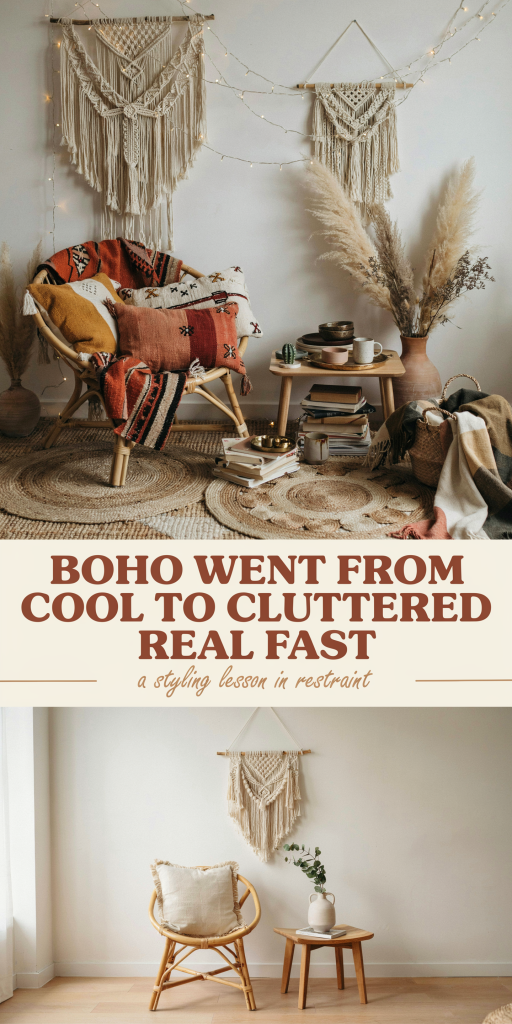
- Texture turned into visual noise. Layering is meant to create depth: when everything wants attention, nothing reads as intentional. Too many rugs, cushions, and wall hangings in competing colors create visual static.
- Pattern without hierarchy. Mixing prints is a boho hallmark, but when scale and color harmony aren’t considered, patterns fight rather than complement. Small geometric motifs stacked against large floral prints often clash.
- Overused props. Certain items, woven baskets, rattan furniture, pampas grass, became shorthand tokens. When every room contains the same set of props, the look becomes formulaic and cluttered.
- Plant overload without purpose. Plants add life, but indiscriminate placement can block light, crowd surfaces, or gather dust-filled micro-ecosystems.
- Inauthentic “artisan” goods. Mass-market imitations often lack the decisive craft marks that make true handmade items interesting, they become decorative filler instead of narrative pieces.
We’ll keep these failure modes in mind as we move toward corrective strategies: refine texture, create pattern hierarchy, and choose objects that tell a story rather than fill a shelf.
The Role Of Retail And Social Media In Accelerating Clutter
Retailers and social platforms didn’t invent boho, but they accelerated its drift toward clutter. Retailers responded to demand for the look with production lines that churned out similar items at scale. Lower prices and high visual similarity meant buyers could buy the look quickly, often without a guiding aesthetic principle. That encouraged homes with many pieces but few curated narratives.
Social media intensified the problem. Algorithms favor contrast, color saturation, and density because those images stop thumbs. Content creators learned to layer and repeat motifs to craft a signature style. Soon, feeds were full of near-identical rooms, and users replicated them, amplifying uniform clutter across thousands of homes.
We also saw a packaging effect: product photography presented items in fully accessorized settings, implicitly suggesting that more equals better. The solution requires pushing back both at point-of-sale and in our feeds: we need to make editing a visible, celebrated part of boho. When retailers show how to pare back and influencers model restraint, we incentivize smarter consumption and healthier spaces.
Minimalist Principles To Rescue Boho Without Erasing Its Character
Rescuing boho isn’t about swapping it for minimalism, it’s about borrowing minimalist principles of restraint, negative space, and visual hierarchy to let boho’s warmth breathe.
- Edit ruthlessly. Put systems in place: adopt a ‘one in, one out’ rule for decorative objects and textiles. We should ask whether each item contributes story, texture, or function.
- Create focal points. Choose one or two statement pieces, a handcrafted rug, an oversized plant, or a piece of art, and let everything else support those anchors rather than compete.
- Limit your palette. Instead of every color in the rainbow, pick two dominant tones and one accent. This reduces visual friction while still allowing pattern and craft to shine.
- Embrace negative space. Empty surfaces and uncluttered corners are not wasted: they’re moments of calm that make textured elements read as intentional.
- Prioritize provenance and quality. Genuine handmade pieces provide variation and interest without needing multiples. Fewer authentic items are more compelling than many lookalikes.
These principles let us keep boho’s tactile, collected feeling while reducing the sensory load that made it feel cluttered.
Practical Room-By-Room Fixes To De-Clutter And Refine The Boho Aesthetic
We’ll apply the rescue principles room by room. Each space needs an anchor, a reduced palette, and clear editing rules. Below are actionable tactics that retain boho’s charm while improving function and flow.
Living Room: Pare, Anchor, And Rebalance
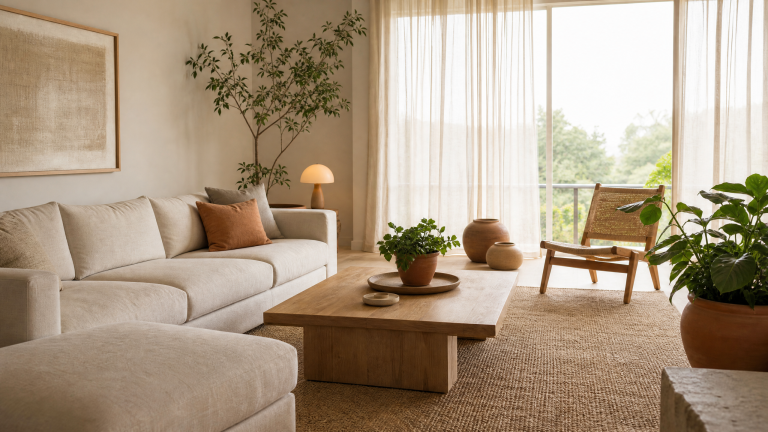
Start by removing everything that’s purely decorative and doesn’t serve comfort or story. Keep three to five textiles max (sofa throw, two cushions, one rug). Choose one anchor piece, an artisanal coffee table or a statement rug, and reposition seating to highlight it. Replace small, competing tables with a single large surface to avoid visual fragmentation. If you love plants, pick varied heights but limit to three main specimens so light and sightlines remain clear. Lighting should be layered but purposeful: a floor lamp near seating, a pendant or sconce for ambient light, and a single smaller lamp for mood. Finally, create negative space on walls, one gallery cluster or a single oversized wall piece reads calmer than dozens of small frames.
Bedroom And Personal Spaces: Simplify Layers And Surfaces
Bedrooms must feel restful. Strip bedding to a dominant neutral base (linen or cotton sheets) and add one patterned blanket or throw. Limit bedside items to essentials: lamp, book, and one personal object. Clear surfaces of multiples, if you’re a collector, let one shelf or a single niche tell that story rather than scattering pieces across dressers. For wardrobes, practical storage is a must: baskets and bins keep textiles out of sight, which dramatically reduces perceived clutter. Curtains should be simple: avoid excessive valances or layered drapes that gather dust and break lines. The aim is a curated, tactile cocoon, not a display case.
Entryway And Small Spaces: Edit For Function And Flow
Small spaces amplify clutter: they demand stricter editing. In entryways, give each functional need its own solution: a bench with hidden storage, a slim coat rack, and one catch-all bowl. Keep eyeballs moving by layering vertical and horizontal elements sparingly, one mirror above a console table, one plant beside a woven basket. In bathrooms and alcoves, remove duplicates of things we seldom use. Swap open shelving for closed storage where possible to reduce visual noise. These small edits create a sense of order that makes boho’s textures feel intentional rather than haphazard.
A Smart Shopping And Editing Checklist For Sustainable Boho
We finish with a practical checklist to guide purchases and ongoing editing. Use this when you’re tempted to buy another pillow, drift into impulse purchases online, or plan a room refresh.
- Pause before you buy. Wait 48 hours and revisit the item in your cart. Does it fill a gap or duplicate something you already have?
- One-in, one-out. For every new decorative item or textile, remove one similar item from the room. This rule disciplines accumulation.
- Ask three questions: Does it have a story? Does it serve a function? Does it harmonize with our palette? If the answer is ‘no’ to two of these, skip it.
- Prioritize quality over quantity. Choose handcrafted, durable pieces even if they cost more, authentic items age better and reduce the need for frequent replacements.
- Edit quarterly. Schedule a seasonal edit: replenish textiles that need laundering and remove items that no longer fit the room’s rhythm.
- Photograph before-and-after. We’re visual animals: taking photos helps us see when a space feels busy even if we’ve acclimated to it.
- Use storage creatively. Baskets, closed cabinets, and under-bed storage keep the visual field uncluttered while preserving the collected feel.
Conclusion: Rescuing boho is a balance of restraint and celebration. We don’t want to strip away personality, just to make it readable. By applying editing rules, limiting palettes, investing in fewer authentic pieces, and designing with focal points and negative space, we can preserve boho’s soulful warmth without the overwhelm. These steps help us create homes that feel curated rather than crowded, spaces that welcome us in and let every item tell its part of the story.