15 Vision Board Ideas To Manifest Your Best Year Yet
We all want a year where things align: clearer goals, steady progress, and a few delightful surprises. A vision board can be the simplest, most tangible tool to steer us toward that kind of year. It’s more than pretty pictures on a poster, when done right, a vision board clarifies priorities, programs our attention, and nudges our daily choices. In this guide we’ll explain what a vision board actually does, the psychology behind it, how to prepare, fifteen concrete vision board themes and prompts to kick-start our year, design best practices, daily rituals to amplify manifestation, and common pitfalls to avoid. By the end, we’ll have everything we need to create a vision board that doesn’t sit in a closet, but works.
What Is A Vision Board And How It Helps Manifestation
A vision board is a curated visual collection, photos, words, clippings, symbols, arranged to represent the life we want to build. Think of it as a physical résumé for our future: it highlights the experiences, feelings, and outcomes we’re aiming to invite. The practice of making a vision board asks us to choose deliberately: what do we value? What would a successful year look like?
Manifestation gets a lot of mystique, but at its core it’s about aligning intention with action. A vision board helps in three concrete ways:
- Clarification: Selecting images forces us to translate vague wishes into specific goals. “Be healthier” becomes “run a 10K,” “sleep eight hours,” or “meal-prep every Sunday.”
- Directional attention: Our brains prioritize what we focus on. When we regularly see our goals, we’re more likely to notice opportunities and make decisions that support them.
- Emotional rehearsal: Images trigger feelings. When we feel the joy, pride, or calm associated with a goal, we’re more motivated to take the small, consistent steps that produce real results.
We should remember a vision board isn’t magic, it’s a tool that synchronizes our mental, emotional, and behavioral systems toward a desired outcome. That alignment is where manifestation does its real work.
Why Vision Boards Work: The Science And Psychology
There’s more than folklore behind a vision board, cognitive science and psychology offer explanations for why this simple practice can be effective.
Selective attention and the reticular activating system (RAS): The RAS is a network in our brainstem that filters incoming stimuli and decides what’s important. When we repeatedly direct attention to certain goals, the RAS starts prioritizing information related to them. That’s why, after we decide to buy a red car, we suddenly notice red cars everywhere. A vision board trains our RAS to spot opportunities aligned with our goals.
Visualization and motor priming: Research shows that vivid mental rehearsal activates many of the same neural pathways as actual practice. Athletes use visualization to improve performance: entrepreneurs and creatives can do the same. Looking at images tied to a goal primes the brain for actions that make the goal more likely.
Emotional valence and motivation: Images that evoke strong positive emotions increase intrinsic motivation. When our vision board sparks enthusiasm, we’re more likely to persist through the inevitable friction of pursuing a goal.
Goal specificity and implementation intentions: The psychological research on goal-setting shows that specific goals beat vague aspirations. When a vision board includes clear, specific visuals, images of the job we want, the city we’ll live in, the daily routine we’ll keep, it helps us form implementation intentions: “If X happens, I will do Y.” Those intentions dramatically increase follow-through.
Finally, social and identity signals matter. A vision board helps us actively craft an identity, “we are runners,” “we are organized,” “we are home cooks.” Acting in line with that identity creates a feedback loop that reinforces the behaviors we want.
How To Prepare Before You Create Your Vision Board
Preparation determines how useful our vision board will be. Rushing straight to Pinterest and glue sticks often produces an attractive collage that lacks intention. Here’s a practical pre-creation checklist to make our board purposeful.
- Do a brief values audit (15–30 minutes)
List our top 5 values (examples: health, creativity, security, adventure, relationships). Values act as a compass so our board reflects deeper priorities rather than fleeting wishes. - Review last year (20–40 minutes)
What worked? What didn’t? Where did we make progress, and where did we stall? This helps us set realistic but meaningful targets. - Set 3–6 headline goals (30–60 minutes)
Decide on a small number of focus areas for the year, these become the core themes of the vision board. Too many goals diffuse attention. - Gather materials and inspiration (30–90 minutes)
Collect magazines, printouts, photographs, quotes, stickers, and textured materials. Create a folder of images on your phone or in a cloud drive if you prefer a digital board. - Choose a format and location
Will this be a physical poster, a framed collage, or a digital wallpaper? Pick a size that fits the space where we’ll see it daily, above our desk, on the bedroom wall, or as a phone background. - Set simple time boundaries
Schedule a two-hour session for creation: allow a follow-up hour for refinement. Treat it like a creative appointment with ourselves.
Preparing this way makes the creation process smoother and ensures our finished vision board is rooted in intention.
15 Vision Board Ideas To Inspire Your Best Year
Below are fifteen vision board themes and concrete prompts we can use to build a focused, inspiring board. We can pick a handful that align with our headline goals or combine several into a single board.
- Career Leap
Images: an office or workspace we admire, a promotion celebration, a specific company logo, a certificate.
Prompt: What role or responsibility would make our workdays exciting and sustainable? - Financial Freedom
Images: a number that represents savings or passive income, a debt-free stamp, a peaceful home.
Prompt: Visualize monthly passive income or an emergency fund balance. - Health & Fitness Routine
Images: a pair of running shoes, a weekly meal-prep tray, a sleep tracker, meditation scene.
Prompt: Picture what a sustainable daily routine looks like: short strength sessions, consistent sleep, and wholesome meals. - Habit Architecture
Images: a checklist, a calendar with streaks, morning ritual items (water glass, journal).
Prompt: Which one keystone habit would change our weeks? Focus the board around that habit. - Creative Projects
Images: studios, finished products, gallery openings, book covers.
Prompt: Show the process from blank page to published/finished work. - Relationship Nourishment
Images: shared meals, candid conversations, trips with friends or family.
Prompt: Visualize the quality of connection we want rather than specific people. - Travel & Adventure
Images: a map pin, a skyline, a campsite, list of three must-visit places.
Prompt: Instead of generic wanderlust, pin exact destinations and the emotions we want to collect. - Home & Environment
Images: organization systems, a calm bedroom, a productivity-savvy workspace.
Prompt: Envision not just the look, but the function, what will our space enable us to do? - Learning & Mastery
Images: textbooks, certificates, a classroom, mentor portraits.
Prompt: Identify one skill to master and the milestones along the way. - Mindset & Emotional Health
Images: peaceful landscapes, affirmations, therapy symbols, breathwork cues.
Prompt: Choose phrases and visuals that reflect the inner state we want to cultivate. - Community & Giving Back
Images: volunteers, donation symbols, community gatherings.
Prompt: Add concrete commitments, hours per month, organizations to support. - Personal Brand & Presence
Images: a stylistic moodboard of colors, fonts, outfits, LinkedIn profile snapshots.
Prompt: Clarify the public-facing image we want and small steps to align our content and network. - Micro-Adventures & Joy
Images: coffee dates, weekend hikes, new recipes, short classes.
Prompt: Pin small, repeatable joys that keep our energy high throughout the year. - Time Freedom & Boundaries
Images: clocks, an open calendar slot, family time.
Prompt: Visualize protected focus blocks and evenings without email. - One-Year Milestone Map
Images: a timeline with quarter markers, small celebratory images for milestones.
Prompt: Break the year into quarters and show the major wins we want by each quarter.
We don’t have to use all fifteen ideas, pick the ones that light us up and make them specific. For example, instead of “travel more,” pin an image of the exact coastal town we’ll visit and the activity we’ll do there. Specificity turns passive wishing into concrete planning.
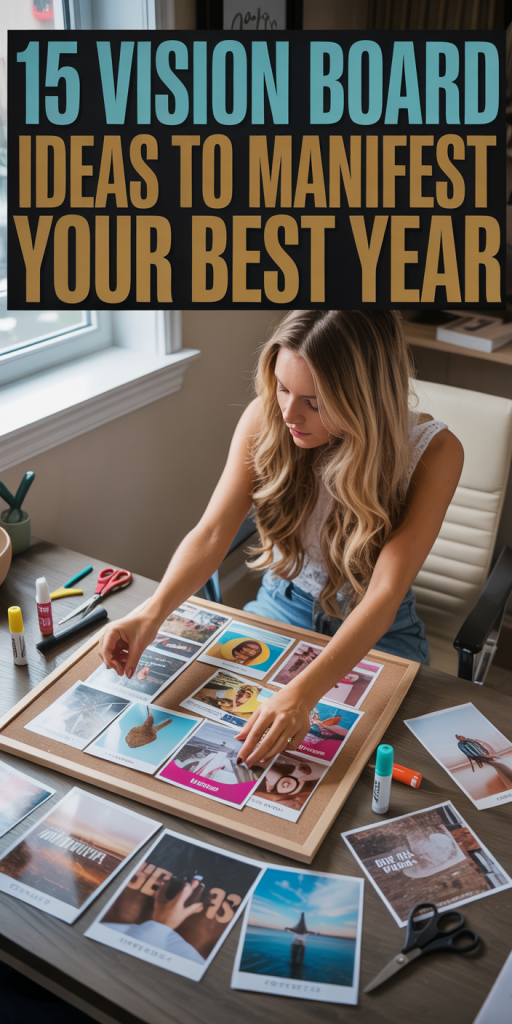
Design Tips For A Powerful, Visually Effective Vision Board
A vision board needs to be both emotionally resonant and easy to scan. Here are design principles that make it more actionable.
- Limit focal points (3–6)
Too many central elements dilute attention. Choose a handful of big visuals that represent our headline goals. - Use hierarchy and whitespace
Give each focal area room to breathe. Use larger images for primary goals and smaller ones for supporting intentions. - Choose a color palette
A coherent palette unifies the board and increases visual resonance. A calming palette (soft blues, greens) supports wellness goals: vibrant hues energize career and creative vision boards. - Mix imagery and words
Pair photos with short, specific captions or affirmations (“Run 10K by June,” “Save $10,000”). Words anchor images with measurable targets. - Include process visuals, not just outcomes
Don’t only show trophies, show the daily scenes that lead to the trophy: morning runs, grocery prep, focused desk time. Process images cue behavior. - Add tactile elements (physical boards)
Stickers, fabric swatches, or textured paper increase attachment and make the board feel more real. - Ensure readability and placement
If the board will double as a phone wallpaper, maintain legibility at small sizes. For wall boards, put the primary elements at eye level. - Keep evolving
Treat the first version as draft one. Pin it for a week, then swap out anything that doesn’t consistently inspire us.
Design decisions shouldn’t be about perfection. They should help the board be seen, felt, and acted on.
How To Use Your Vision Board Daily To Boost Manifestation
Creating the board is step one, using it daily is where the work pays off. Here are practical daily rituals to keep our intentions active.
- Morning 3-minute scan
Spend three minutes each morning looking at the board. Notice one image that resonates and name one small action we’ll take that day to move toward it. - Nightly gratitude alignment (2–5 minutes)
Before bed, look at the board and list one thing from the day that brought us closer to a vision. Gratitude strengthens motivation and encodes progress. - Weekly micro-review (10–20 minutes)
Once a week, evaluate progress on the board’s headline goals. Tweak images or captions to reflect shifting priorities. - Integration into planning
Use the board when setting weekly or monthly goals. Ask: Which item on our to-do list aligns with the board? If none, we’re not allocating time to what matters. - Visual triggers for behavior
Place process images near tools: a picture of meal-prep next to the fridge, a running photo on the treadmill. These contextual cues nudge action at the point of decision. - Phone background or digital duplicates
If we’re on our phones constantly, create a simplified digital version. A lock-screen reminder with one or two visuals can be surprisingly effective. - Share and commit
Telling a trusted friend or accountability partner about our board and the top 1–2 actions we’ll take increases follow-through.
Consistency matters more than intensity: three minutes a day adds up to a steady reorientation of attention and behavior. When we pair daily viewing with deliberate micro-actions, the board moves from wishful thinking to a practical planning tool.
Common Mistakes To Avoid When Making A Vision Board
We’ve seen beautiful boards that never change a life, not because the idea is flawed, but because of avoidable mistakes. Here are common traps and how to avoid them.
Mistake 1: Vagueness
- Problem: Generic images (“happy people”) offer no actionable direction.
- Fix: Use specific images and captions that define what success looks like.
Mistake 2: Overcrowding
- Problem: A cluttered board is hard to parse and easy to ignore.
- Fix: Limit focal points and embrace whitespace.
Mistake 3: Creating and forgetting
- Problem: The board gets made, then tucked away.
- Fix: Place it where we’ll see it daily and pair viewing with a short ritual.
Mistake 4: Focusing only on outcomes
- Problem: Outcome-only vision boards skip the behaviors that cause outcomes.
- Fix: Add process images and micro-habits that lead to the result.
Mistake 5: Relying solely on positive thinking
- Problem: Positive images without planning generate short-lived inspiration.
- Fix: Combine the board with implementation intentions and concrete deadlines.
Mistake 6: Perfectionism
- Problem: Waiting for the “perfect” board delays action.
- Fix: Build a draft, use it for a month, then iterate.
Mistake 7: Misaligned values
- Problem: Pinning goals that don’t fit our deeper values leads to friction.
- Fix: Start with values and choose images that align with them.
Avoiding these mistakes turns the vision board from a decorative object into a disciplined tool.
Conclusion
A vision board is a surprisingly strategic tool when we approach it with clarity and follow-through. It helps us name what matters, primes our attention, and cues the behaviors that produce real change. Our recommendation: spend careful time preparing, pick 3–6 headline goals, focus on both outcomes and processes, and build daily micro-routines around viewing the board. Treat the first board as an experiment, refine it quarterly. When we pair a thoughtfully designed vision board with consistent, measurable actions, we don’t just wish for our best year yet, we actively create it.