How to Decorate Small Spaces So They Feel Bigger and Brighter
Small spaces don’t have to feel cramped, dim, or uncomfortable. With intentional design choices we can open up square footage, invite more light, and create rooms that feel larger than they really are. In this guide we walk through practical design principles, furniture and layout strategies, color and finish choices, lighting, window treatments, flooring, storage solutions, and styling tips that collectively transform small rooms into airy, functional spaces. Whether you’re outfitting a studio apartment, a compact living room, or a snug bedroom, these techniques are straightforward and adaptable, and they’ll make a noticeable difference right away.
Core Design Principles For Making Small Rooms Feel Spacious
Scale, Proportion, And Visual Balance
We begin with scale: furniture and objects should be proportional to the room. A large sectional in a tiny living room swallows visual space: a few well-chosen, scaled-down pieces create openness. Opt for lower-profile sofas, narrow armchairs, and tables with exposed legs to keep sight lines clear. Visual balance matters too, distribute weight across the room so one corner isn’t visually heavier than another. Use grouping (three or five objects rather than many singles) to create purposeful clusters that read as intentional instead of cluttered.
Maximizing Natural Light And Sight Lines
Natural light is the fastest way to make a room feel bigger and brighter. We prioritize unobstructed windows, reflective surfaces, and layouts that let light flow through. Keep large furniture away from window planes and avoid blocking sight lines from entry to the far wall. If possible, orient seating to face or receive natural light: even a small chair near the window changes how light animates the room. When daylight is limited, treat the room as if it has more windows: bright paint, mirrors, and layered lighting will help emulate that effect.
Creating A Clear Visual Flow
A clear visual flow reduces visual noise and makes movement feel effortless. We think of the room as a path: entry, primary activity area, secondary zones (reading nook, desk). Arrange furniture so pathways are obvious and uninterrupted. Use rugs, lighting, and furniture placement to define zones without erecting physical barriers. Consistent finishes and a restrained palette help the eye move smoothly, which contributes to a perception of expanded space.
Space Planning And Furniture Strategies
Choose Multifunctional And Appropriately Scaled Furniture
In small rooms, every piece should earn its keep. We favor multifunctional furniture: sleeper sofas, nesting tables, ottomans with storage, and desks that double as console tables. A well-chosen multiuse item reduces the total number of objects, which instantly frees up space. Scale remains crucial, choose pieces with slimmer profiles, shorter backs, and exposed legs to preserve visual depth.
Floating Furniture And Open Pathways
Floating furniture (pulling pieces away from walls) can paradoxically make a room feel larger when done sparingly. It creates breathable space around items and opens pathways. We often float a sofa with a low console behind it, or place chairs away from corners to allow circulation. Keep primary pathways at least 28–36 inches wide where possible so movement feels natural.
Furniture Arrangement To Expand Perceived Space
Arrangement can change perception more than new purchases. We arrange seating to emphasize the room’s longest dimension, using rugs and lighting to lengthen sight lines. Angle furniture slightly to avoid monotonous, boxy layouts, a gentle diagonal can create depth. Where practical, position furniture to allow views across the room rather than blocking them: transparency helps too (glass tables, open shelving). Finally, keep a small breathing-room clearance between pieces: it signals an uncluttered environment and reinforces spaciousness.
Color, Paint, And Finishes To Brighten And Enlarge
Best Paint Colors And Undertones For Small Spaces
Light, warm neutrals are the safest bet when we want brightness and perceived volume. Whites with subtle warm undertones, soft greiges, pale blues, and muted greens can reflect light without feeling clinical. The trick is to test paint swatches under the room’s actual lighting at different times of day. Cooler whites can recede visually, while warm whites invite a cozy but open feel. Avoid high-contrast small-scale patterns on walls, they tend to make spaces feel busy and smaller.
Using Accent Walls And Continuity To Lengthen Rooms
Accent walls still work in small rooms when used to create depth. Rather than a bold contrasting color, we prefer a slightly deeper hue of the primary wall color or a textured finish that draws the eye down the length of the space. Continuity across trim, doors, and walls, such as painting them the same tone, reduces visual breaks and reads as more spacious. Consider vertical accents to emphasize height or a horizontal tone shift to stretch a room’s width, depending on which dimension you want to enhance.
Trim, Ceiling, And Finish Tricks To Add Height And Light
Painting the ceiling a shade lighter than the walls or the same color as the walls can add perceived height. Glossy or satin finishes on trim will bounce light and create subtle dimension. We also use lighter tones on moldings and door frames to avoid heavy framing that chops up space. If you want to exaggerate height, paint a thin band of lighter color where wall meets ceiling: it tricks the eye into reading the ceiling as higher than it is.
Lighting Design: Layers That Add Depth And Warmth
Natural Light Optimization
We maximize daylight by keeping windows unobstructed, choosing low-profile treatments, and using reflective surfaces to distribute light. Even small rooms benefit from light shelves (narrow reflective ledges) and strategically placed mirrors that bounce sun into darker corners. When possible, reposition furniture so sunlight travels across the room instead of being blocked at its source.
Ambient, Task, And Accent Lighting Solutions
Layered lighting is essential. Ambient light provides overall illumination: recessed fixtures or a centrally placed flush-mount can do the job without dominating the ceiling. Task lighting, table lamps, under-cabinet lights, swing-arm sconces, focuses light where we need it, preventing the temptation to crank ambient lighting higher. Accent lighting (LED strips behind shelves, picture lights, or a small uplight) adds depth and highlights vertical planes, making the room feel more dimensional.
Fixture Selection For Minimal Visual Clutter
We choose fixtures with simple silhouettes and light finishes to avoid visual clutter. Transparent or openwork pendant lights, slim-profile sconces, and fixtures with reflective interiors increase perceived brightness without becoming focal points. In low ceilings, opt for flush or semi-flush fixtures that provide broad, even light: in taller spaces, a deliberate pendant can create vertical drama without crowding the room.
Windows, Treatments, And Hardware Choices
Sheer Curtains, High Rod Placement, And Full-Length Drapes
Window treatments are opportunities to add height and light. We hang rods close to the ceiling, even a few inches higher than the window frame, and use full-length drapes that reach the floor. Sheer panels soften and diffuse light while maintaining privacy: when paired with a heavier side panel, they give flexibility without sacrificing brightness. High rod placement elongates the wall visually, making ceilings feel taller.
Blinds, Shades, And Privacy Without Blocking Light
If privacy is a concern, top-down/bottom-up shades and light-filtering blinds are excellent. They let us lower coverage from the top while keeping the lower sash private, or vice versa. Choose light-filtering fabrics rather than blackout for daytime use. Bamboo or woven shades can add texture but select versions that allow some light through or pair them with sheers to prevent darkening the space.
Hardware And Trim To Create A Framed, Airy Look
Slim hardware and minimalistic curtain rods reduce visual weight. We prefer narrow brackets and simple finials so the window appears framed rather than boxed. Paint window trim in the same color as the wall or slightly lighter to avoid hard edges: alternatively, paint trim a touch darker if you want the window to act as a framed focal point without closing the room in.
Flooring And Rug Strategies To Unify The Space
Continuous Flooring And Color Flow Between Rooms
Continuous flooring between rooms, using the same wood, laminate, or tile, reduces visual breaks and creates a sense of flow. We advocate seamless transitions from living area to dining or kitchen where possible: this visual continuity makes the entire footprint read as one larger space. If you must change flooring types, use complementary tones and keep pattern changes minimal.
Rug Size, Pattern, And Placement To Define Zones
Rugs define zones without erecting physical barriers. A too-small rug chops a space and makes it look disjointed. We choose rugs that at least accommodate the front legs of primary furniture pieces (sofas, chairs) to anchor them. Keep patterns modest in scale, large, simple patterns read as expansive, while tiny, busy patterns can shrink perception. Neutral or lightly contrasted rugs maintain brightness and cohesion.
Low-Profile Materials To Keep Sight Lines Open
Low-pile rugs, thin runners, and slim thresholds preserve sight lines and make cleaning easier. In small spaces, bulky mats or high-pile carpets can feel heavy and trap light. Where elevation changes are unavoidable, use gradual transitions and matching tones so the eye isn’t interrupted abruptly.
Storage, Organization, And Decluttering For Spaciousness
Vertical And Hidden Storage Solutions
We use vertical space for storage, tall bookcases, wall-mounted cabinets, and floating shelves keep floor area open. Hidden storage is a game-changer: benches with lids, ottomans with compartments, and beds with drawers conceal belongings and reduce surface clutter. Think up: high shelves for infrequently used items, hooks for bags and coats, and a pegboard in the kitchen or entry for flexible storage.
Decluttering Routines And Editing Your Belongings
Spaciousness is as much about what we remove as what we add. We recommend a simple decluttering routine: quarterly edits, a donate/trash/sell sorting system, and a rule of thumb, if you haven’t used it in a year and it has no sentimental value, consider letting it go. Keep surfaces mostly clear: display only a few curated objects to maintain personality without overwhelming the space.
Smart Built-Ins And Furniture With Storage
Custom built-ins can optimize awkward nooks and make storage feel integrated rather than tacked on. Window seats with drawers, built-in wardrobes, and shallow wall cabinets use depth cleverly while keeping circulation unimpeded. When custom isn’t an option, modular systems and slim-profile cabinets provide flexibility and keep the room tidy.
Mirrors, Reflective Surfaces, And Glass To Amplify Light
Where To Place Mirrors For Maximum Impact
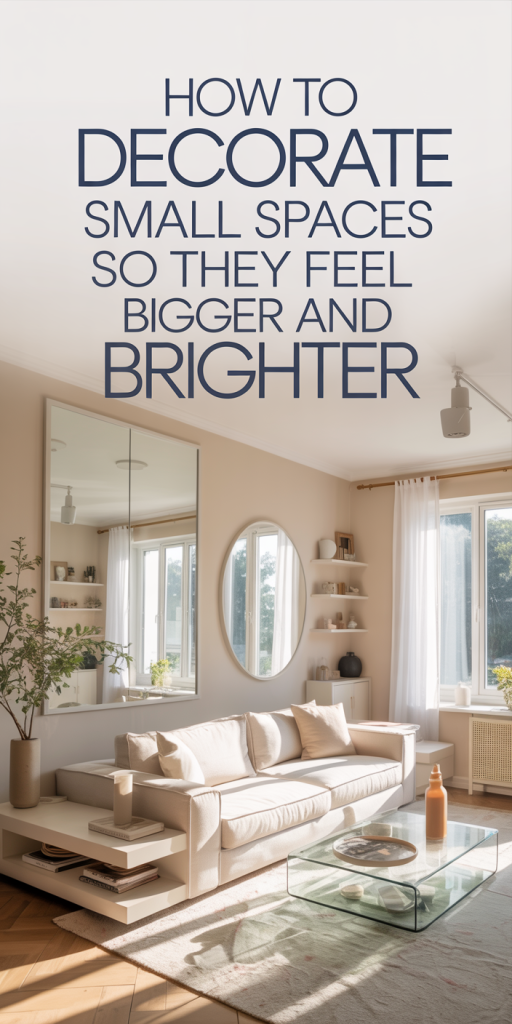
Mirrors double perceived space when placed thoughtfully. We position mirrors across from windows to bounce natural light back into the room or on a wall that faces the room’s primary seating area to create depth. Floor-length mirrors leaning against a wall add verticality: a cluster of smaller mirrors can create an interesting focal point without overwhelming the space. Scale the mirror to the wall, too small and it’s decorative only: too large and it can feel disorienting.
Using Glass, Gloss, And Metallics Without Overwhelming
Glass tables and furniture with glass elements maintain sight lines and reduce visual mass. Glossy finishes on cabinetry or furniture reflect light but should be used judiciously to avoid a clinical feel. Metallic accents, brass knobs, chrome lamp bases, add sparkle: we balance them with matte surfaces and natural textures so the space feels warm rather than shiny. Subtlety is the key: a few reflective touches are enough to lift the room.
Using Glass, Gloss, And Metallics Without Overwhelming
Glass tables and furniture with glass elements maintain sight lines and reduce visual mass. Glossy finishes on cabinetry or furniture reflect light but should be used judiciously to avoid a clinical feel. Metallic accents, brass knobs, chrome lamp bases, add sparkle: we balance them with matte surfaces and natural textures so the space feels warm rather than shiny. Subtlety is the key: a few reflective touches are enough to lift the room.
Accessories, Textiles, And Styling For An Airy Feel
Scale And Restraint In Artwork And Decorative Objects
Accessories should support the room’s scale. A single large artwork can be more impactful than a crowded gallery wall in a small space. We choose frames with narrow profiles and matting that gives breathing room. Decorative objects are best used in small curated groups, three items at varied heights, for example, rather than scattered singles. That restraint keeps surfaces feeling intentional and airy.
Textile Choices That Add Texture Without Weight
Textiles add warmth but can also weigh a room down if overly heavy. We choose lighter-weight throws, linen or cotton curtains, and low-pile cushions to introduce texture without bulk. Keep a consistent color story for textiles to maintain continuity. Layering textures in similar tones rather than contrasting bold colors helps preserve a light, cohesive feel.
Plants, Greenery, And Finishing Touches To Liven A Room
Plants bring life and help define corners without closing space. Choose upright or trailing plants rather than bushy varieties that fill floor area. Hanging planters, wall-mounted pots, or tall narrow plants in corners add green without clutter. Finish with a few personal touches, a meaningful book stack, a small tray for keys, a scented candle, but resist the urge to over-accessorize. The goal is personality with airiness.
Conclusion
Making small spaces feel bigger and brighter comes down to thoughtful restraint and layered solutions. We combine correct scale, intelligent layout, reflective surfaces, and layered lighting with continuous finishes and smart storage to produce rooms that feel open and intentional. Start with decluttering and natural light, then layer in furniture, color, and accessories that support flow and brightness. With a few deliberate changes, a mirror in the right spot, a lighter paint, a multifunctional sofa, we can dramatically shift how a room feels. Small rooms can be beautiful, functional, and full of light when we design them with purpose.