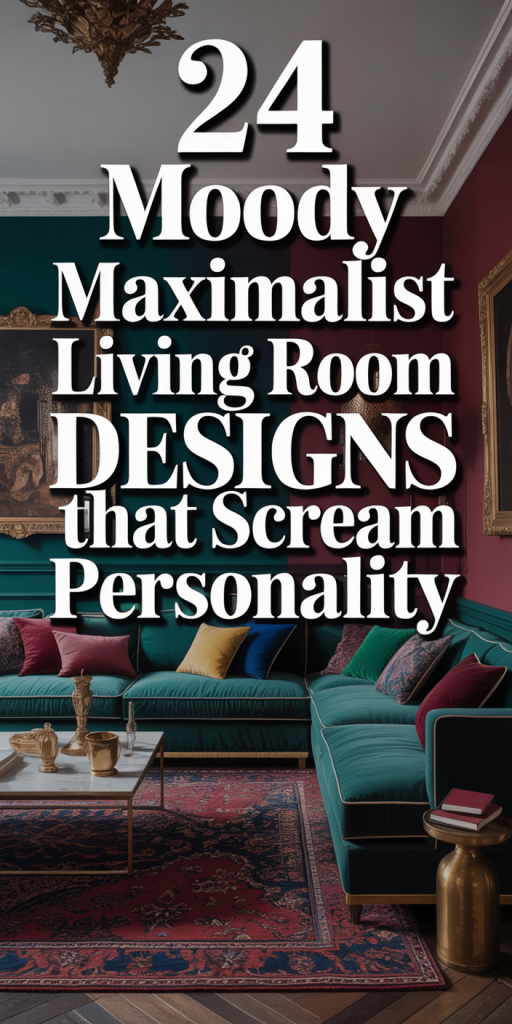
24 Moody Maximalist Living Room Designs That Scream Personality (Without Being Tacky) — Bold Ideas for 2026
Moody maximalism feels like the antidote to safe, beige living rooms: it embraces rich color, abundant pattern, and layered texture while still reading deliberate and curated. In 2026, the trend has matured, we’re no longer chasing excess for shock value. Instead, we want rooms that tell a story: rooms that feel lived-in, dramatic, and unmistakably personal without tipping into kitsch. In this guide we’ll explain why moody maximalism works, give concrete rules to keep things tasteful, and walk through color, furniture, textiles, lighting, and finishing details. Finally, we’ll highlight 24 inspiring room examples and the exact elements you can steal for your own space. Read on if you’re ready to dial up personality while keeping the results polished.
Why Moody Maximalism Works: Mood, Scale, And Storytelling
Moody maximalism succeeds because it engages three core design levers: mood, scale, and storytelling. First, mood. Deep, saturated colors, think inky blues, forest greens, oxblood, and charcoal, change how a space feels. They absorb light, create intimacy, and make texture more visible. That intimacy invites people to linger, making the living room feel like a refuge rather than a staged showroom. Second, scale. Maximalism isn’t simply “more stuff”: it’s about intentional density. Oversized art, layered rugs, and generous furniture proportions anchor the room so the visual weight feels purposeful. When scale is balanced, a busy room reads as curated abundance rather than clutter. Third, storytelling. Layering objects with varied provenance, ceramics from travel, inherited textiles, contemporary sculptures, gives the space narrative depth. Each piece becomes a punctuation mark in a broader conversation.
The modern, moody maximalist approach also benefits from contemporary restraint: we pair opulent surfaces with quiet moments and use repetition to create rhythm. Contrast is key, a velvet sofa in a saturated hue pops against matte black shelving, while gilt frames gain sophistication when surrounded by dark, muted walls. Eventually, moody maximalism works because it leverages emotion. We design for atmosphere first, then refine for function, and the result is living rooms that feel intentionally expressive rather than accidental.
Five Rules To Keep Maximalism From Feeling Tacky
Rule 1, Curate, don’t hoard. We choose objects with meaning or strong aesthetic purpose: every visible item should justify its place. A thoughtful edit beats volume every time.
Rule 2, Control the palette. Limit the core palette to two to three moody hues and a handful of neutrals. Predictable color anchors keep visual chaos readable.
Rule 3, Mix finishes intelligently. Balance glossy and matte, warm metals and blackened iron. Too many competing finishes make a room feel disjointed: a dominant finish with one or two accents reads cohesive.
Rule 4, Repeat and echo. Repetition of shape, color, or material across the room provides rhythm. If we introduce a curved silhouette in a sofa, echo it in a mirror or lamp to harmonize the composition.
Rule 5, Mind the negative space. Even the most layered design benefits from pockets of calm, an unadorned wall, a clear tabletop, or a simple woven basket. These breathing spots prevent sensory overload and let key pieces shine.
Apply these rules early: before you bring in rugs, art, or accessories, define your palette and dominant finishes. From there we let pattern and objects add personality in measured doses.
How To Choose A Moody Color Palette
Choosing the right moody palette is about atmosphere and contrast. Start with an anchor, a deep, saturated hue that will dominate walls or a primary upholstery piece. Consider how natural light interacts with that anchor: north-facing rooms tolerate richer tones without feeling gloomy, while sun-filled rooms can handle near-black shades.
Next, select two supporting hues. These might be cousins in the same family (teal and petrol blue) or complementary (deep plum with moss green) to create depth. Keep the chroma similar so the colors feel of a piece rather than of multiple competing threads.
Finally, choose neutrals. In moody maximalism, neutrals are not only beige: they can be raw linen, warm taupe, chalky gray, or even bleached wood. Neutrals offer relief and make the saturated colors readable. We also recommend including one high-value contrast, a small area of near-white, a brass detail, or a mirror, to lift the palette and avoid visual heaviness.
Pairing Moody Hues With Neutrals For Balance
Pairing moody hues with neutrals requires attention to undertone. A blue with green undertones pairs well with warm grays and beige: a purple bias calls for cooler neutrals. Use neutrals in larger surfaces, ceilings, trims, rugs, to give the eye rest. For example, a graphite wall with a warm oatmeal rug and ivory curtains reads balanced and refined. Textural contrast also helps: matte plaster walls combined with a slubby linen sofa create tactile interplay that keeps the scheme from feeling flat.
Using Accent Colors And Metallics To Lift The Scheme
Accent colors and metallics are the punctuation marks of moody maximalism. Introduce a vivid accent, a mustard pillow, coral ceramic, or citrine glass, sparingly and purposefully to create focal points. Metallics, used strategically, add luminosity: warm brass warms dark palettes, while burnished nickel or blackened bronze offers modern edge. We tend to limit metallics to two types to avoid competing reflections. Place metallics near natural light or accent lamps so they catch the eye without dominating the composition.
Furniture And Layout Tips For Moody Rooms
Furniture choices in a moody maximalist room should be bold in proportion but disciplined in silhouette. We favor large-scale seating, deep sofas, generous armchairs, upholstered in rich materials like velvet, boucle, or heavyweight wool. These tactile fabrics read luxurious against dark backdrops. Keep lines clean: when silhouettes are simple, layers of pattern and object won’t fight the core pieces.
Layout matters more than you might expect. Anchor seating with a strong focal point: fireplace, oversized artwork, or a statement media console. Create conversation clusters rather than a single linear arrangement: this encourages social use and allows us to place curated surfaces, side tables, poufs, stacked stools, that introduce secondary textures and colors.
Balance is key. If you have one visually heavy item (an ornate bookcase or sculptural sofa), counter it with lighter elements across the room, slender-legged tables, airy pendant lights, or open shelving. And finally, prioritize comfort: deep seats and well-placed lighting make dramatic rooms feel cozy rather than theatrical.
Textiles, Patterns, And Layering Techniques
Textiles are where maximalism shines. Layering rugs, a textured sisal under a patterned kilim, creates depth and delineates zones. We mix patterns by scale: a large floral or abstract rug with medium-scale geometric pillows and a small-scale, linear throw. That scaling hierarchy keeps patterns legible.
Mix fiber types to add dimensionality. Combine nubby wool, smooth silk, handwoven cotton, and leather accents so light and touch interplay differently across surfaces. For window treatments, heavier drapery in moody hues grounds the room while linen sheers soften light: pair both for filtered drama.
Don’t forget textiles beyond soft goods: upholstered panels, fabric-wrapped books, and textile-backed cabinets act as canvas for pattern without clutter. When in doubt, test one patterned element against the wall color before committing to multiple patterns, it’s easier to add complexity than to dial it back.
Lighting And Finishing Touches That Add Depth
Lighting defines how moody colors read. We design layered lighting: ambient (overhead), task (reading lamps), and accent (picture lights, uplights). Warm color temperature bulbs (2700–3000K) keep saturated hues feeling inviting rather than cold. Dimmer switches are essential, they let us modulate intensity and reveal finishes differently throughout the day.
Finishings and hardware are tiny but powerful decisions. Choose hardware that complements the room’s mood: oil-rubbed bronze or blackened steel for gritty, dramatic schemes: aged brass or champagne gold for warmer, sumptuous tones. Mirrors with dark or antique frames amplify light without breaking the palette.
Finally, accessorize with restraint. Group objects into vignettes of odd numbers, vary heights, and use trays or sculptural bowls to contain small pieces. Houseplants with sculptural leaves, fiddle leaf fig, rubber plant, monstera, bring life and soft contrast to heavy palettes while echoing an organic color layer.
24 Inspiring Room Examples And What To Steal From Each
We’ve curated 24 room ideas, here are the highlights and the elements to borrow for your own moody maximalist living room.
- Inky Library Chic: Deep navy walls, floor-to-ceiling shelves in matte black, leather Chesterfield. Steal: continuous shelving and mixed metal sconces.
- Velvet Jewelbox: Emerald velvet sofa, smoked glass coffee table, carved wood sideboard. Steal: single-saturation sofa with carved wood accent.
- Plummy Eclectic: Plum walls, layered Persian rugs, gilt-framed art gallery. Steal: a curated gallery wall with consistent framing.
- Terracotta Luxe: Burnt orange walls, rattan accents, brass arc lamp. Steal: warm saturated paint plus natural fiber balance.
- Moody Modern Farmhouse: Charcoal shiplap, boucle armchairs, pottery cluster. Steal: texture contrast and ceramic vignettes.
- Gothic Revival Update: Oxblood sofa, black lacquer console, Tudor-style mirror. Steal: dramatic mirror as focal point.
- High-Contrast Minimal: Almost-black walls with white sculptural sofa and limited accessories. Steal: low-visual-noise maximalism, choose one dominant contrast.
- Botanical Maximalism: Forest green walls, layered plants, botanical prints. Steal: living wall grouping and terracotta pots as punctuation.
- Pattern-Rich Boho: Mixed kilims, embroidered pillows, macramé hanging. Steal: pattern scaling and handmade textiles.
- Curated Collector’s Room: Glass cabinets, collected objet, museum lighting. Steal: use vitrines to give small pieces prominence.
- Luxe Library Corner: Leather club chair, reading lamp, floor-to-ceiling books. Steal: dedicated reading nook with focused task lighting.
- Retro Glam: Mustard boucle chairs, starburst mirror, lacquered coffee table. Steal: one vintage silhouette to anchor the scheme.
- Coastal Noir: Deep slate walls, driftwood table, blue-gray textiles. Steal: incorporate weathered natural surfaces to soften dark color.
- Moroccan-Inspired Den: Patterned tiles, low seating, brass lanterns. Steal: tile as accent and small-scale floor cushions.
- Industrial Elegance: Exposed brick, black steel, velvet seating. Steal: combine industrial shells with soft upholstery.
- Luxe Monochrome: Varied charcoal tones, tactile throws, matte black hardware. Steal: tonal layering within one hue family.
- Art-Focused Studio: Bold wallpaper, oversized canvas, sculptural lighting. Steal: make a single artwork the organizing principle.
- Warm Minimal Maximal: Cocoa walls, minimal furniture, rich textiles. Steal: keep forms simple and textures bold.
- Color-Blocked Drama: Blocks of teal, ochre, and graphite with mid-century furniture. Steal: geometric color zoning to create movement.
- Patterned Ceiling Surprise: Painted ceiling, patterned plaster, low-profile seating. Steal: treat the ceiling as a fifth wall.
- Layered Rug Gallery: Three rug layers, low-slung sofa, poufs. Steal: rug layering to define zones and add warmth.
- Dark Scandinavian: Muted black walls, light wood accents, cozy throws. Steal: Scandinavian restraint in silhouettes with moody tones.
- Maximalist Minimalism: Sparse layout but intense pattern and color in select pieces. Steal: restraint in object count with bold focal items.
- Global Traveler’s Room: Mix of tribal textiles, carved masks, lacquered trunks. Steal: curated travel finds arranged like a collection.
For each idea, we recommend taking one or two features rather than copying an entire look. That way the room retains cohesion while reflecting your personality. Start with the larger decisions (wall color, primary sofa, main rug), then add smaller steals, a mirror, a lamp, a plant, to complete the story.
Conclusion
Moody maximalism in 2026 is about thoughtful abundance: bold colors, meaningful objects, and layered texture composed with clear rules. We encourage experimentation, try a single moody wall, introduce one saturated sofa, or layer two rugs, but always curate. When we combine scale, mood, and storytelling with restraint and repetition, the result is living rooms that scream personality without ever feeling tacky. Use the 24 examples above as a cheat sheet: borrow one or two moves, calibrate them to your light and lifestyle, and let the room evolve. The best moody maximalist rooms aren’t finished projects, they’re ongoing collections that change with us.