When Minimalism Goes Too Far: How To Make Your Home Feel Warm Again In 2026
We loved minimalism for the clarity it brought: fewer things, less visual noise, and a sharper focus on what truly matters. But lately many of us are waking up to the other side of that coin, rooms that look tidy in photos but feel hollow in real life. In 2026, minimalism is no longer a fringe aesthetic: it’s a default for apartment listings, design blogs, and social feeds. That ubiquity has carried an unintended consequence: homes that read as empty rather than serene. In this text we’ll trace how minimalism crossed from calming to clinical, identify the signs our spaces have become emotionally flat, and give practical, low-effort strategies to restore warmth and personality without abandoning the principles we value. Think of this as a repair kit, small changes, big payoff.
Why Minimalism Became The Default — And How It Crossed The Line
Minimalism rose as a counterpoint to consumer culture and cluttered living. In the early 2010s, influencers and authors framed minimalism as liberation: remove what doesn’t add value, and suddenly life feels lighter. That message resonated: we embraced streamlined wardrobes, neutral palettes, and multipurpose furniture. It made practical sense, smaller homes, remote work, tighter budgets, and it photographed well, which multiplied its influence.
But a few developments nudged minimalism past the useful into the extreme. First, platforms rewarded clean, ‘Instagrammable’ interiors. Algorithms favored flat-lay shots and sparse vignettes, teaching creators to edit spaces for the camera rather than for living. Second, the aesthetic became synonymous with a moral choice: to buy less is to be ethical and disciplined. While well-intentioned, this created pressure to remove anything that didn’t look curated, even if it brought comfort or utility.
Finally, design thinking prioritized form over residue: matching sets, hidden storage, and neutral palettes can all be beautiful, until they erase evidence of life. We began treating rooms like galleries, where objects are judged primarily by their contribution to a visual story. That’s when minimalism crossed the line: from a tool for focus to a rulebook that punishes personality.
Recognizing this trajectory matters because it helps us separate the philosophy’s benefits from its pitfalls. We can keep the clarity and intentionality while rejecting austerity that leaves our homes emotionally barren.
Signs Your Minimalist Home Feels Empty Instead Of Serene
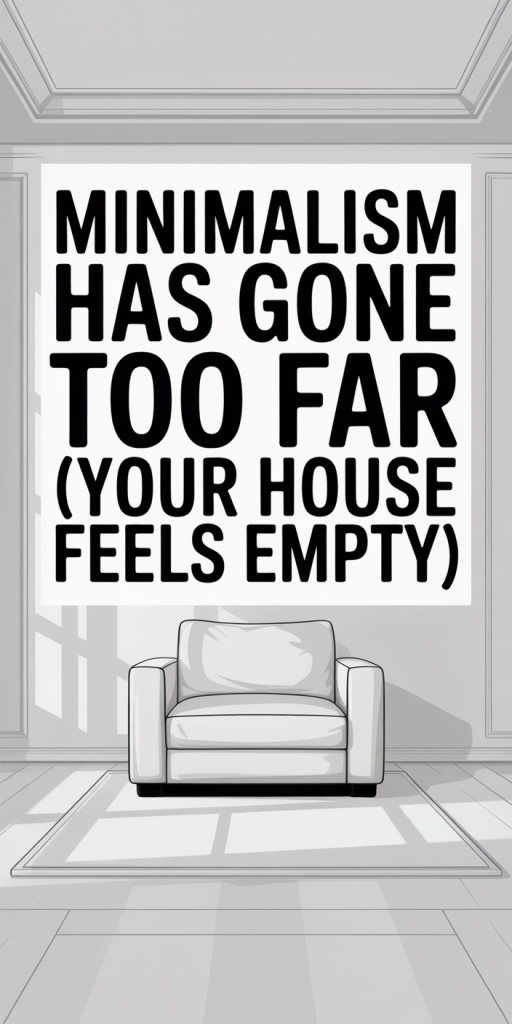
It can be tricky to tell whether your home is peacefully minimal or painfully empty. We recommend looking for a few reliable signals, they’re less about how many things you own and more about how the space supports everyday life and our emotional needs.
First, notice how long you linger in rooms. If you rush through the living room straight to the kitchen because the space doesn’t invite you to sit, that’s a red flag. Second, check how you feel when guests arrive: do you feel proud and relaxed, or anxious and performative? Empty rooms often create a performance pressure where hospitality feels staged rather than spontaneous.
Third, evaluate daily functionality. Are you constantly opening drawers to find things you used to display? Do you make compromises, stacking books on the floor, improvising cushions, because storage and surface areas are minimized? Those micro-frictions add up and indicate that minimalism has prioritized appearance over use.
Finally, listen to your bodily responses. Bare floors can feel colder underfoot: hard surfaces amplify noise: and a lack of tactile elements can make sitting or resting less comfortable. If your physical experience of the home feels thin, the minimalism is likely too extreme.
How Extreme Minimalism Affects Mood, Productivity, And Relationships
Our environment shapes cognition and emotion more than we often admit. When minimalism becomes extreme, it can blunt positive emotional cues and interfere with daily rhythms.
Mood: A warmly layered space triggers comfort and ease: it signals safety and belonging. Conversely, sterile environments can increase anxiety or a feeling of disconnection. We might notice dips in motivation or an overall sense of blandness. For people prone to loneliness or depression, an emotionally barren home can magnify those feelings because there are fewer reminders of connection: photos, mementos, or books that anchor identity.
Productivity: Minimalism initially seemed ideal for focus, fewer objects, fewer distractions. But when a workspace is too sparse, it can feel cold and uninspiring. We need tactile stimuli and visual anchors to sustain attention and creativity. A desk with nothing but a laptop can make long stretches of work feel monotonous. Thoughtful objects, a sketchbook, a plant, a small lamp, provide micro-breaks for the brain, improving sustained productivity.
Relationships: Hospitality and intimacy rely on environments that invite lingering. When we remove cozy seating, soft lighting, or communal surfaces, we unintentionally discourage long visits. Guests may stay shorter, conversations might run less deep, and routine rituals, baking together, board games, movie nights, can feel logistically awkward. That’s not an abstract loss: those activities are often how we maintain friendships and family bonds.
In short, extreme minimalism can reduce atmospheric richness that supports emotional health, creative work, and social life. Reintroducing warmth is often the quickest way to reverse those effects.
Quick, Low-Effort Fixes To Make Your Space Feel Warmer Today
We don’t have to stage a renovation to make our homes feel inviting. Start with simple, reversible changes that bring texture, color, and life back into rooms. These fixes are low-cost and high-impact, perfect for busy lives.
- Layer textiles: Throw blankets and cushions add instant warmth both visually and physically. Choose fabrics with texture, wool, boucle, linen, and introduce one or two accent colors to break the monotony. Don’t overthink pattern: a single patterned cushion can change a sofa’s entire personality.
- Switch to warmer bulbs: Lighting is one of the easiest levers to pull. Swap cool, clinical LEDs for warm (2700–3000K) bulbs in living areas. Add dimmers where possible: being able to lower brightness shifts a room from ‘display’ to ‘dwelling.’
- Introduce plants: Greenery softens hard edges and improves acoustics slightly by breaking sound reflections. Choose low-maintenance plants like pothos, snake plant, or ZZ if we’re not naturals at gardening. Even a few stems in a vase on the dining table signals life.
- Add a rug: A well-sized rug anchors furniture and absorbs sound. It instantly reduces echo and provides a tactile surface underfoot. If we can only pick one permanent change, a rug is often the most transformative.
- Curate a functional vignette: Place a small stack of books, a candle, and a personal object on a coffee table or shelf. These curated spots look intentional while restoring personality.
- Reintroduce a scent: A subtle reed diffuser, candle, or simmer pot gives a space an immediate homey feel. Scent evokes memory and comfort: using it strategically can make rooms feel occupied.
Each of these changes is reversible. The point isn’t to pile on things, but to reintroduce sensory cues that remind us we live there. We recommend making one change per week, it feels manageable and lets us notice what truly improves the vibe.
Bring Back Personality Without Undoing Your Minimalism
We can reintroduce personality while keeping minimalism’s strengths: order, clarity, and restraint. The trick is intentionality, selecting a few meaningful elements and displaying them with purpose.
Start by setting a small limit: allow one shelf, one wall, and one tabletop to be the personality zone. That constraint prevents the ‘slippery slope’ where one vignette turns into cluttered surfaces everywhere. Within those zones, pick objects that tell a story: a travel memento, a set of mismatched ceramics, or a stack of books that reflects our interests.
Color strategy helps maintain cohesion. Keep the larger pieces neutral and reserve accents for those personal zones. That way, the room reads as calm overall but offers surprise and warmth when you look closer.
Another technique is functional personality: items that are used and seen. A record player, a basket of throw blankets, or a favorite cookbook on a stand both signal life and serve a purpose. This approach reduces dusting and the pressure of ‘dust collectors’ because these objects are part of our routines.
We should also consider rotating displays. Instead of committing to every object permanently, rotate three to five items seasonally. This keeps the space fresh without adding volume: it’s like curating a tiny gallery where the collection changes.
Finally, avoid apologetic placement. Display personal items confidently, not hidden behind glass or tucked in drawers. When we own our objects visibly and tastefully, the space immediately feels inhabited and authentic.
Conclusion
Minimalism gave us clarity and freedom, but like any tool it can be overapplied. In 2026 we’re learning to hold the philosophy lightly: keep what simplifies and supports us, reintroduce what warms and sustains us. Small changes, layered textiles, warmer lighting, a few plants, and intentional displays, restore comfort without undoing the calm minimalism offers.
We don’t have to choose between order and personality. By curating with purpose and addressing practical gaps, we can create homes that look refined and feel lived-in. Let’s make spaces that welcome us back, every day.