16 Nail Designs That Are Doing Too Much (And How To Wear Them Less Loudly)
We love a statement manicure as much as anyone, bold colors, inventive textures, and personality-packed art are part of why nails are a form of self-expression. But there’s a line between creative and cacophony. In this piece we look at 16 nail designs that are doing too much: the trends that can overwhelm your look, snag your clothes, or just feel like too much energy for everyday life. For each one we’ll explain what makes it excessive, when it actually works, and how to wear the same idea in a more wearable, polished way. Whether you’re a nail addict, salon owner, or someone who wants a refined mani that still turns heads, we’ll help you keep the drama without overdoing it.
Maximalist Chrome And Full-Mirror Finishes
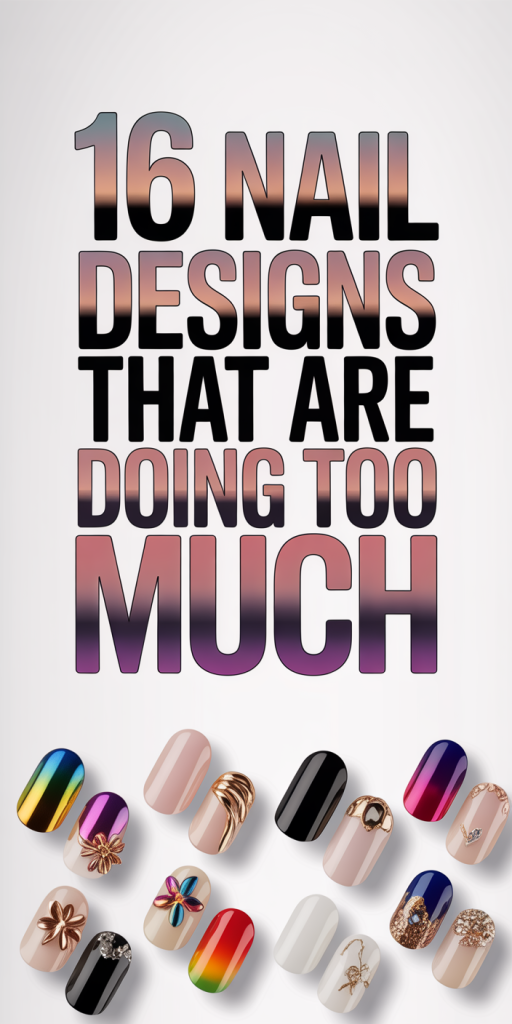
Chrome and mirror finishes became an instant classic when the trend landed: ultra-reflective, futuristic, and perfectly smooth. But when the chrome covers every finger from cuticle to tip, layered with multiple shades, sharp gradients, or jagged metallic accents, it can read as heavy-handed and look like costume jewelry rather than polish.
What makes it too much: full-mirror mani leaves zero negative space and draws maximum attention. Any imperfection, growing out, or chip shows immediately, and layered metallics can create a cluttered visual effect that clashes with jewelry and outfits.
When it works: for events, editorials, or short-lived photo shoots where impact is the goal, full-mirror is unbeatable. It also looks striking on a single accent nail or a short, square canvas where the light catches cleanly.
How to wear it less loudly: pick a single chrome accent nail instead of a full set, or limit mirror finishes to tips (reverse French) or crescent moons at the cuticle. Another subtle move: combine a matte base with a glossy chrome stripe. That contrast keeps the reflective appeal but softens the overall glare. Finally, choose warmer chromes (rose gold, bronze) if you want a luxe look that blends with everyday accessories rather than screaming for attention.
All-Over Gems, Rhinestones, And 3D Embellishments
We adore sparkle, but covering every nail in 3D gems can feel like carrying tiny chandeliers on your fingers. Full-coverage rhinestones, giant pearls, and clusters of studs are visually heavy and often impractical: they snag hair, rub against fabric, and fall off after a day or two, leaving an uneven finish.
What makes it too much: volume and placement. When embellishments cover nails from base to tip and spill over edges, they dominate the hands and compete with rings and bracelets. They also shift the focus from nail shape, polish quality, and skillful art to sheer ornamentation.
When it works: for bridal looks, red carpets, or editorial spreads where drama is intended, maximalist 3D nails are show-stopping. Short-term wear at special events gives you the effect without the maintenance headache.
How to wear it less loudly: adopt a restrained placement strategy. Use gems on a single accent nail, create a minimalist border along the cuticle, or choose micro-crystals instead of chunky stones. Another option is to embed flat foiled accents under gel so the sparkle reads smooth and refined. We recommend pairing modest embellishments with a clean base color, nude, soft pink, or sheer, to keep the overall aesthetic sophisticated.
Busy Mixed-Pattern Mani: Clash Of Prints And Textures
Mixing patterns is a fun way to express personality, but when every nail becomes a different loud print, animal spots, checkerboard, florals, and geometric lines, the result can be chaotic rather than curated. Busy mixed-pattern manis often lack a visual anchor, leaving the eye nowhere to rest.
What makes it too much: too many competing motifs, colors, and textures on one hand without an organizing theme. Clashing scales and color temperature (neon next to muted pastels) create visual dissonance and can make hands look smaller or messier.
When it works: editorial or avant-garde sets where the goal is maximal visual interest. Also great for summer festivals or themed shoots where the chaos is intentional.
How to wear it less loudly: create cohesion. Choose one unifying element, a repeating color, a consistent line weight, or a shared motif, and limit the variety to two or three complementary patterns. Use negative space or a neutral base to break up the busyness. For example, do two patterned nails, two solid nails in a coordinating color, and one nail with a subtle metallic stripe. That balance reads intentional and stylish instead of overwhelming.
Extreme Negative Space With Intricate Linework
Negative-space manis are a modern staple because they marry simplicity with clever design. But when minimalism gets into a matchbook of delicate, intersecting linework across every nail, tiny triangles, micro-grids, and hairline swirls, the look can paradoxically feel overworked. Intricate lines demand precision: any smudge or growth ruins the effect.
What makes it too much: hyper-detailed negative space saturates the nail with micro-patterns that are difficult to execute and maintain. The result often reads as fussy, especially at a normal viewing distance where the details merge into visual noise.
When it works: on short nails or as an accent where the negative space serves as a minimalist punctuation rather than the entire sentence. It’s excellent in close-up beauty shots or when you’re showing off nail artistry.
How to wear it less loudly: simplify the geometry. Reduce the number of lines per nail, choose slightly bolder strokes instead of ultra-fine hairlines, and leave more clear space around the design. Pair intricate linework with a single solid-color nail to create breathing room. Also consider scale: enlarge the design so it reads cleanly from a conversational distance rather than requiring a magnifying glass.
Overstretched Acrylics, Ten-Plus Lengths, And Sculpted Tips
Long nails have an undeniable glamour, but lengths beyond what’s practical, we’re talking ten inches of sculpted acrylics, can feel exaggerated and sometimes unsafe. Overstretched acrylics and extreme sculpting (exaggerated coffin curves, razor edges) can make everyday tasks awkward and increase breakage risks.
What makes it too much: disproportionate length relative to hand size, aggressive sculpting that prioritizes shape over function, and layered embellishments that make the nail top-heavy. These sets can intimidate wearers and onlookers, often signaling trend-chasing more than personal style.
When it works: performances, drag, runway, and editorial shoots where dramatic silhouette is the objective. In those contexts, scale and spectacle are assets.
How to wear it less loudly: scale to your lifestyle. Opt for medium-length extensions that elongate without impairing function. Choose softer tip shapes (rounded square, almond) that are easier to live with. If you love sculpted details, limit them to two or three nails rather than every finger. We also suggest reinforcing tips with thinner overlays and avoiding ultra-sharp edges that catch and chip.
Full-Coverage Foil, Glitter Bombs, And Holographic Sheets
All-over foil, industrial glitter bombs, and holographic sheets are undeniably attention-grabbing, but an entire set done in these finishes can feel visually noisy. Full-coverage foil reflects every light source and can read garish if paired with clashing textures or saturated patterns.
What makes it too much: overwhelming reflectivity and texture, plus a tendency to look cheap when not applied cleanly. Holographic sheets and chunky glitter also highlight imperfections in the nail surface and chip quickly if not sealed properly.
When it works: festival season, New Year’s Eve, or when you want maximum sparkle in a short burst. Applied correctly, these finishes can be show-stoppers for events.
How to wear it less loudly: use these elements as accents rather than the entire treatment. Try a glitter gradient from the base or tip into a neutral polish, or apply foil to just the edges for a subtle metallic frame. For holographic effects, select a soft, diffused holo on one accent nail rather than a mirror-like sheet across all fingers. Finally, always finish with a strong gel topcoat to reduce flaking and keep the effect chic instead of sloppy.
Excessive Themed Art: Mini Scenes, Logos, And Tiny Portraits On Every Nail
There’s a thrill to telling a story across nails, landscapes, brand logos, and tiny portraits can be clever and cute. But when each nail is a separate, highly detailed scene the set starts to feel cluttered and gimmicky. Tiny portraits and complex logos demand fine detail work that’s often lost at normal viewing distances.
What makes it too much: visual complexity and lack of coherence. If every nail is competing for attention with its own mini-story, the hand becomes a collage rather than a cohesive canvas. This is also a maintenance problem: detailed art chips and requires precise touch-ups to stay presentable.
When it works: when the art is deliberately miniaturized and meant for close inspection, think content creators, brand activations, or themed photoshoots.
How to wear it less loudly: choose one or two focal nails for the detailed scenes and complement them with understated coordinating shades or textures on the remaining fingers. Alternatively, simplify the scenes to strong silhouettes or single motifs repeated across nails to create a unified narrative without visual overload. We also recommend scaling up the most important element so it’s legible at arm’s length rather than microscopic.
How To Tone Down An Over-the-Top Mani Without Losing Style
When we want the drama but not the distress of an over-the-top manicure, there are consistent strategies that preserve personality while dialing back excess. First, adopt restraint in placement: accents on one to two nails read intentional: accents on all ten read loud. Second, unify your palette: limiting shades to two or three related tones keeps varied textures from clashing.
Scale matters. Upsize the motif or downsize the detail so your nails are legible and chic from a normal conversational distance. Negative space is your friend, a clear margin around complex art or sparkle makes designs breathe and feel tasteful. Balance texture with smooth finishes: pair a glitter accent with satin or matte nails to create contrast without chaos.
Practical tips: opt for smaller embellishments, secure crystals with gel overlays, and choose shorter, more manageable lengths. If you like color intensity but not the commitment, try removable press-ons for special occasions so you can enjoy the look without long-term maintenance. Finally, tell your nail tech the exact situations you want the nails for, work, travel, event, so they can design something both beautiful and functional.
Conclusion
We’re big fans of expressive nail art, but excess can tip a look from stylish to impractical. The common thread across these 16 examples is scale, placement, and cohesion: when any of those elements are out of balance, the mani starts doing too much. By choosing one focal point, simplifying palettes, and prioritizing wearable shapes and placements, we can keep the fun and lose the overwhelm. A thoughtfully edited manicure still turns heads, it just does it with better taste and less maintenance. Try one restrained adaptation from this list next time you book a salon visit and notice how much more versatile your mani becomes.