Open Shelving Is Destroying Tiny Kitchens: Why It Fails And What To Do Instead (2026 Guide)
Open shelving showed up in magazine spreads and influencer posts as the antidote to closed, cookie-cutter cabinetry: airy, stylish, and supposedly space-saving. But in tiny kitchens the story is different. We’ve watched dozens of small apartments and compact homes adopt open shelves only to find usable storage vanish, surfaces gather grime, and visual clutter take over the space that needed clarity the most. In this guide we’ll walk through how open shelving became a dominant trend, why it disproportionately fails in small kitchens, the real design and safety consequences, and practical alternatives that deliver the look without sacrificing function. If you’re trying to make a tiny kitchen feel larger and actually work for daily life, read on, this is the advice we wish we’d had years ago.
Why Open Shelving Became A Kitchen Design Trend
Open shelving rose to prominence for a few clear reasons, and none of them are inherently bad. First: visibility. Nothing sells the idea of a brighter, more open kitchen faster than removing bulky upper cabinets and replacing them with slim shelves. That visual trick, less wall mass, more sightlines, makes photos and walkthrough videos sing. Second: the lifestyle angle. Open shelves promise to showcase curated dishware, artisan ceramics, and the kind of carefully arranged glassware that suggests a calm, curated life. Third: cost and DIY appeal. In many cases, floating shelves are cheaper and easier to install than custom cabinetry, which made them irresistible for renters, first-time homeowners, and budget-minded remodels.
But trends aren’t only about aesthetics: they’re about context. The images that popularized open shelving tended to be shot in relatively roomy kitchens with lots of natural light and homeowners who were prepared to do constant styling. Those conditions don’t map directly onto tight urban kitchens, college-town rentals, or vacation condos where daily cooking, limited storage, and quick turnovers are the reality.
We also can’t ignore social-media dynamics. Instagram and TikTok amplify the glamorous exceptions, an immaculate shelf with a perfect stack of plates, making that curated look feel achievable for everyone. In reality, the visual shorthand of “open shelf = stylish kitchen” glosses over the ongoing maintenance, storage losses, and behavioral changes required to keep that look intact.
So why did open shelving become popular? Because it promised immediacy: light, style, and a fast upgrade, especially appealing in the early 2020s when homeowners sought inexpensive, high-impact updates. The problem is that the promise wasn’t conditionalized enough: it rarely came with the caveat “only if you have space, time, and the patience to style and maintain it.”
How Tiny Kitchens Amplify Open Shelving’s Problems
Tiny kitchens expose the gaps between aspiration and everyday life. When you have limited square footage, every cubic inch of storage matters: what looks like an airy styling choice on a mood board can translate into a real loss of functional storage in a tight footprint. Here’s how the mismatch plays out, and why small kitchens magnify the downsides of open shelving.
First, tiny kitchens usually demand maximum enclosed storage to hide the mess of daily cooking, leftover containers, mismatched Tupperware, cleaning supplies, and pantry overflow. Replacing closed upper cabinets with open shelves removes the easiest place to tuck those items out of view. Second, tiny kitchens often have fewer horizontal surfaces and prep space: the few uninterrupted walls may be the only options for vertical storage that keeps items protected. Third, the visual density of a small space means that what would read as ‘styled’ in a large kitchen reads as cluttered in a compact one. The eye in small spaces notices every object: stacks of dishes and jars create visual noise that makes the room feel smaller, not larger.
We’ve also seen behavioral realities bite: in small households or busy families, dishes get left out to dry, shopping bags pile up, and groceries don’t always get rearranged into neat rows of mason jars. Open shelves demand a higher level of discipline in both purchasing and daily habits, discipline that’s harder to sustain when the kitchen is the central hub for a household and space is already tight.
Finally, small kitchens often lack the ventilation and airflow that keep airborne grease and moisture from settling on exposed items. That chemical and particulate load accelerates wear on dishware and increases cleaning requirements. That brings us to a pair of consequences that matter most in practice: the loss of usable storage and the maintenance burden that comes with exposed surfaces.
Loss Of Usable Storage
The first practical blow tiny kitchens take from open shelving is a stealthy one: usable storage disappears, not necessarily in total cubic feet, but in usable, realistic, daily-storage. Cabinets with doors let us stack irregular items, hide unattractive packaging, and use corner shelving systems, lazy Susans, and pull-out organizers to maximize every inch. Open shelves, by contrast, implicitly encourage uniformity. They reward matching sets and neat stacks, and punish the pragmatic pile of mismatched bowls or the emergency stash of paper towels.
Think through a typical day: we unload the dishwasher, put away groceries, and place stray cooking tools somewhere convenient. With closed cabinets, there’s breathing room for those less aesthetic items. Open shelves force decisions: will we hide the cereal boxes in a basket (and then where do we put the basket?), or will we display them on the shelf and accept the visual clutter? In small kitchens, that one decision multiplies because options are limited.
There’s a capacity issue too. Upper cabinets often extend to the ceiling, tapping into vertical storage that open shelves, installed at a reachable height for styling and use, often forgo. And because open shelves encourage leaving frequently used items within easy reach, they tend to occupy prime real estate where taller but less-accessed things could live if they were tucked behind a door.
Finally, from an organizational viewpoint, open shelves make it harder to create distinct zones. We like to keep baking supplies together, breakfast items in one place, daily dishes in another. Cabinets can discreetly define those zones: shelves blur them, and in a tiny kitchen that blurring translates to friction during cooking and cleanup.
Dust, Grease, And The Ongoing Maintenance Burden
Open shelving exposes everything to the environment, meaning dust and airborne kitchen residues land directly on plates, bowls, jars, and appliances. In a small kitchen, where cooking happens within close proximity to everything you own, this exposure is magnified. Grease particles from frying or sautéing don’t just settle on the nearest cabinet: they adhere to open glassware and ceramic surfaces, leaving a dull film that requires frequent washing.
We’ve run experiments and spoken to cleaners who work across cities: the cleaning frequency required to keep open shelves looking ‘styled’ is substantially higher than for closed cabinets. You aren’t just wiping the shelves: you’re washing or re-wiping the items on them. In a busy household, that extra task is often the first to fall off the list, and the shelf devolves from curated to crowded to grimy.
Moisture is another factor. Small kitchens often have less effective ventilation, and steam from pots will condense on exposed items. This can accelerate deterioration of cardboard packaging, labels, and even some finishes on pottery. For people with allergies, the dust accumulation on visible items may be more than an aesthetic problem, it’s a health concern.
Maintenance also has an emotional cost. Open shelving subtly enforces tidiness as a moral obligation: your whole social life feels more visible when your kitchen is tricked out for display. That’s fine for some, but for many it adds stress and makes us less likely to use the kitchen spontaneously. We end up cooking less, hiding more, or investing in storage solutions that defeat the original purpose of “openness.”
Design And Practical Consequences: Clutter, Scale, And Safety
The consequences of open shelving in tiny kitchens fall into three overlapping buckets: visual clutter, scale mismatch, and safety concerns. Each of these affects daily life in ways designers rarely show in aspirational photos.
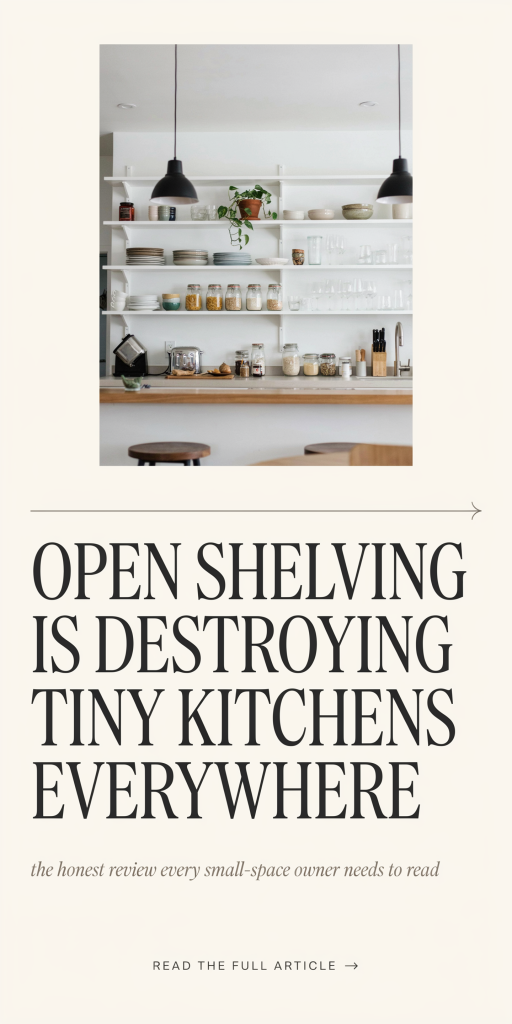
Visual clutter: In a compact space, every object exerts disproportionate visual weight. Shelves that would read as airy in a larger room become dense collections of shapes and colors that fragment the eye. The cognitive load of constant visual noise makes the kitchen feel smaller and more chaotic. We find that people in these environments report frustration with “visual mess” even when surfaces are technically clean.
Scale mismatch: Open shelves often rely on a rhythm of spacing that’s tuned to the proportions of the room. When applied to a tiny kitchen, those proportions break down. A long run of narrow shelves can make a compact wall feel like it’s closing in, particularly if items are stacked high. Conversely, shallow shelves that attempt to minimize bulk sometimes carry too little storage to be useful, forcing us to compensate with more items on the counter.
Safety: Practical hazards increase when frequently used items are stored openly. Glassware or plates stored at an awkward height are more likely to be knocked and dropped in cramped quarters. Children or pets can more easily access items they shouldn’t. And because open shelves encourage items to be placed within easy reach, hot pots or heavier objects might end up too close to the edge. We’ve seen cases where people moved fragile or sharp items to open shelves for convenience and later regretted it after a chip or an accident.
Psychology matters too. The “always-on” display creates pressure to keep things photogenic. In small kitchens that pressure reduces functional spontaneity, people cook less, or cook with fewer tools, because they don’t want to increase visible clutter. That’s a real cost to home life: kitchens are meant to be used, not preserved as museum exhibits.
When Open Shelving Actually Works — And Better Alternatives
We’re not saying open shelving is categorically bad. There are clear scenarios where it works well, and ways to get the same open, airy aesthetic without sacrificing function in small kitchens.
When it works:
- In larger kitchens where the shelf is part of a layered storage system, not a primary one. If you have deep lower cabinets and pantry space, a single run of open shelves can add personality without compromising storage.
- For lightweight, decorative items that aren’t used daily, think a curated display of serving platters or cookbooks, where exposure won’t interfere with function.
- In households where occupants are committed to frequent cleaning and minimalism, and where styling is a sustainable habit rather than a weekend project.
But for tight footprints and everyday kitchens, better alternatives exist. The goal is to preserve the visual openness open shelving promises while maintaining the protective, efficient storage closed cabinetry provides. Below are approaches we recommend and use ourselves when advising on small-kitchen layouts.
Hybrid Solutions, Styling Tricks, And Organization Hacks For Small Kitchens
Hybrid solutions: Combine the best of both worlds by using a mix of closed cabinets and limited open shelving. For example, install closed upper cabinets where you store food, small appliances, and less attractive items, and place a single narrow open shelf at eye level to display a small selection of dishes or plants. Another hybrid approach is to use cabinets with glass-front doors. They visually lighten the wall while protecting items from grease and dust.
Drawer-first thinking: In tiny kitchens, drawers often outperform shelves for accessibility and organization. Deep drawers with dividers can hold pots, pans, and food storage containers more efficiently than a bank of shallow open shelves. Pull-out pantry systems make better use of narrow vertical spaces and keep goods hidden but reachable.
Smart cabinet interiors: Use organizers, stacking shelves, under-shelf baskets, tiered spice racks, vertical plate holders, to maximize the capacity of closed cabinets. When we treat cabinets as dynamic storage systems rather than static boxes, the need to display everything disappears.
Visual tricks for openness: To achieve an airy look without open shelving, opt for lighter cabinet finishes, reflective backsplashes (glass or glossy ceramic tiles), and under-cabinet lighting. A continuous backsplash from counter to ceiling can create one uninterrupted plane that reads as more spacious than fragmented open shelves.
Styling hacks if you insist on shelves: Limit the footprint to one short run, keep color and material palettes tight, and use closed containers and matching baskets to corral visually messy items. Store frequently used and ugly items in drawers below the shelf. We also recommend positioning shelves away from the primary cooktop area to reduce grease exposure and situating them above the sink where steam and splatter are less likely to settle on delicate goods.
Organization: Adopt a “one in, one out” rule for open displays to avoid accumulation. Use labeled, airtight containers for staples that might otherwise degrade when exposed. And commit to a weekly refresh, wipe the shelf and rotate items, so the display doesn’t become a time sink.
If budget allows: Consider custom shallow cabinetry that mimics open shelving’s thin profile but has doors that close. This solution gives you the slim look without exposure, and modern finishes can replicate the warmth and texture open shelves offer.
Finally, think in zones. Keep daily-use items in the most accessible, protected storage (drawers or closed cabinets), and reserve any open display for infrequently used, durable, or purely decorative pieces. That choice preserves functionality while letting us enjoy the aesthetic benefits that drew us to open shelving in the first place.
Conclusion
Open shelving isn’t a design sin, but in tiny kitchens it’s often a mismatch between aspiration and reality. We’ve seen the pattern: a promising makeover leads to lost storage, extra cleaning, and a sense that the kitchen has become a display rather than a place to live. The better path is strategic: use hybrids, prioritize enclosed storage where it matters most, and apply styling sparingly. When we design small kitchens to be used first and admired second, we get both efficiency and calm, without pretending that open shelves are a one-size-fits-all solution.