Why Pinterest Homes Are Starting To All Look Identical — And How To Stop It In 2026
We’ve all scrolled through Pinterest and felt that tiny sinkhole of deja vu: kitchens with the same shaker cabinets, living rooms staged with identical rattan chairs, and bedrooms bathed in the same warm, desaturated hues. That feeling isn’t just a personal quirk, it points to a larger pattern. As Pinterest and similar visual platforms matured, they became powerful design homogenizers, amplifying a narrow set of aesthetics until they feel like the only options. In this text we’ll unpack how that happened, identify the visual tropes dominating feeds in 2026, explore real-world consequences for homeowners and designers, and, most importantly, give practical, actionable strategies to reclaim originality in our homes. If you’re tired of living in a Pinterest clone and want to create a space that reflects you rather than an algorithm, read on.
The Rise Of The Pinterest Home: What The Trend Really Means
Pinterest didn’t invent aesthetic preferences, but it did scale them. What began as a visual bookmarking tool evolved into a discovery engine that rewards clear, aspirational imagery. Over the last decade, homeowners, influencers, and brands learned to optimize for that engine: clean compositions, distinct color palettes, and high-contrast before/after narratives. Those repeatable formats performed well, got repinned, and eventually became the shorthand for “good design.”
But the rise of the Pinterest home is more than a set of pretty pictures. It’s a cultural feedback loop: platform → creators → consumers → more platform content. Each loop narrows what looks “on-trend” and teaches new users to prioritize replication over experimentation. What used to be a source of inspiration now often functions as a template library. That’s useful when we want quick ideas, but it also flattens the diversity of domestic expression.
Importantly, this trend is global. Through algorithmic translation, a farmhouse kitchen in Iowa can become the reference point for a micro-apartment in Seoul. That cross-pollination is valuable, it democratizes access to design ideas, but when the same visuals are amplified everywhere, local and personal distinctiveness gets lost. In short: the Pinterest home is efficient, picture-perfect, and increasingly uniform.
Why Pinterest Feeds Drive Design Homogenization
Several forces conspire to push feeds toward visual sameness. It’s not simply that users like similar aesthetics: the platform’s mechanics and the surrounding creator economy actively reward certain visuals while sidelining others. To understand the mechanics, we need to look at the algorithmic incentives and the economics that make replication the fastest path to visibility and monetization. Below we break these forces into two overlapping drivers: algorithmic reinforcement and creator incentives.
Algorithmic Reinforcement And The Power Of Virality
Algorithms are pattern-finders. Pinterest’s recommender systems prioritize images and layouts that drove engagement in the past, saves, repins, click-throughs. When a specific composition or palette repeatedly produces engagement, the algorithm starts promoting visually similar pins to more feeds. The result is an invisible but predictable narrowing of what’s surfaced.
Virality compounds this effect. A handful of pins can seed millions of impressions: once an image reaches enough people, designers and content creators mimic the successful formula to capture some of that traffic. Those copies then feed the same algorithm, which interprets replication as validation, further amplifying the trend.
We should also factor in metadata and search behavior. Users searching for “cozy living room” or “modern farmhouse kitchen” often click the same high-performing pins, which teaches the system that those exact images represent the query. Over time, the algorithm conflates popularity with representativeness, so the most visible results look alike because they are the most clicked.
Finally, A/B testing and platform nudges encourage creators to adopt successful templates. Pinterest offers creators analytics that implicitly say: “This works.” And when creators optimize for the data, creativity becomes optimization.
In short: the feed isn’t neutral. It’s a machine that rewards repeatable visual signals, and those signals become self-fulfilling.
Creator Incentives, Templates, And The Economics Of Replication
Creators and brands are rational actors operating in a marketplace. They want reach, engagement, affiliate revenue, and brand deals. The fastest route to all of these is to replicate what’s already performing well. Templates, whether for room layout, photography angles, or staging, reduce friction and risk for creators. A tried-and-true template is cheaper and faster than innovating a new approach.
There’s also a commercial pipeline that nudges creators toward homogeneity: product partnerships and affiliate programs favor items that photograph well and fit into the dominant aesthetic. Retailers design collections with Pinterest-friendly visuals in mind because they know those items are more likely to be shared and purchased. Over time, the marketplace optimizes product design to the platform’s most visible trends, closing the loop between commerce and content.
Another economic factor: micro-influencers often monetize through quick wins, a popular pin can translate into affiliate income overnight. Risk-averse creators hence prioritize replication. The net effect is an industry-level pressure to conform: everyone chases what works, which reduces experimentation and broadens similarity across homes.
Common Visual Tropes Of The Pinterest Home
If we want to push back against the Pinteresting of our homes, we first need to identify the tropes that recur in feeds. These aren’t accidental: they’re patterns that satisfy algorithms, photograph well, and translate across cultures. Here are the most pervasive visual motifs we’re seeing in 2026.
Layout, Materials, And Color Palettes That Repeat Everywhere
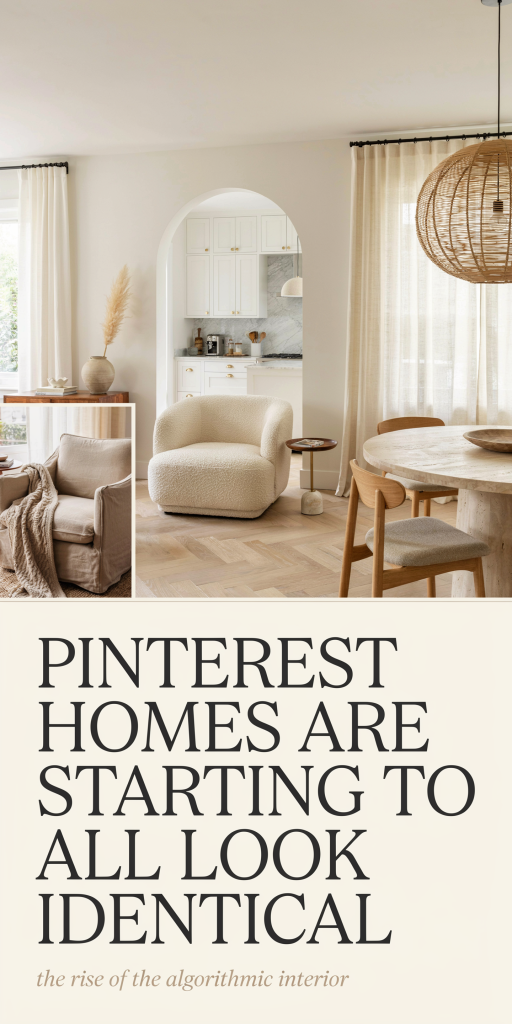
Certain structural choices dominate. Open-plan living that highlights a unified sightline, kitchen to dining to living, photographs as aspirational and tidy. Shaker or flat-panel cabinets in muted whites or off-whites, paired with warm wood islands or butcher-block countertops, create high-contrast focal points that read well on camera.
Materials follow a predictable set: matte black fixtures, brass or aged gold accents, rattan or cane detailing, and stone-look quartz that mimics marble without the cost. Flooring tends toward warm-toned oak or pale wide planks. Rugs are low-profile, neutral, and layered to capture texture without visual noise.
Color palettes have converged too. Muted, desaturated hues, warm beiges, soft greens, and dusty blues, dominate. Accent colors are subtle and often derived from natural tones. The overall effect is calm, cozy, and photogenic, but it also reduces contrast between spaces and cultures: what reads as “modern cozy” in one context looks nearly identical in another.
Styling, Props, And The ‘Staged Casual’ Look
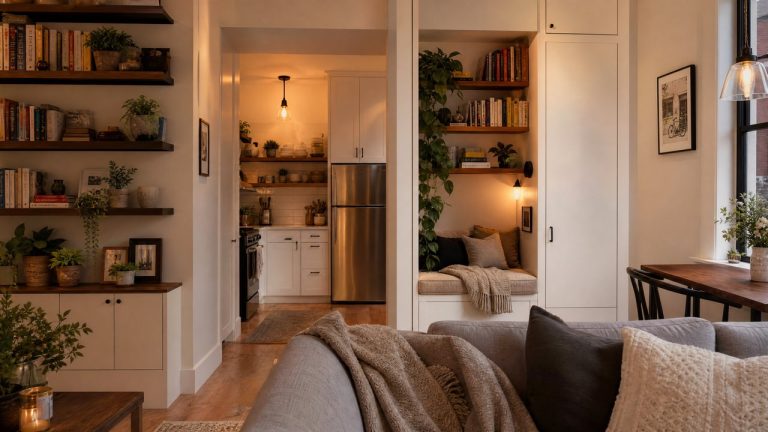
Beyond structure, styling tropes create the Pinterest signature. The staged casual look is a careful choreography of lived-in and stylized: a folded linen throw artfully off-center, a perfectly imperfect stack of books, bowls of citrus strategically placed on marble, and a single stem in a minimal vase.
Props tend to be tactile and natural: woven baskets, hand-thrown ceramics, terracotta planters, and linen textiles. Kitchen counters show curated clutter, a wooden cutting board with a sliced baguette, a jar of wooden spoons, a coffee press, all selected to imply utility without appearing messy.
Lighting is another repeatable cue. Natural light, usually from a southern-facing window, is staged with sheer curtains and warm-toned bulbs to create a golden-hour glow. Photographers favor wide-angle shots that emphasize depth and create the illusion of spaciousness. The cumulative effect is a tableau that feels both attainable and aspirational, which is exactly why it gets copied so often.
Real-World Consequences For Homeowners, Designers, And The Market
Homogenization isn’t just an aesthetic gripe: it has pragmatic consequences.
For homeowners, the easiest outcome is boredom: after a few years, a once-charming Pinterest kitchen can feel generic and impersonal. More seriously, replication can lead to poor fit. Designers who build for the feed sometimes prioritize visuals over function, producing layouts that look great in photos but don’t work for daily life, think narrow islands with insufficient storage or open shelving that collects clutter.
For designers and craftspeople, the economic effects are mixed. On one hand, Pinterest drives demand for certain products, creating sales opportunities. On the other hand, it compresses value: clients expect cheaper versions of high-end looks, and artisans who make bespoke pieces struggle to compete with mass-produced imitations. The market rewards fast, cheap replication rather than slower, local craft.
At a cultural level, homogenization flattens regional and historical identity. Traditional details, local materials, and vernacular architecture are sidelined because they don’t fit the dominant visual script. That’s a loss of richness and context, our built environments code cultural memory into material form, and when we replace that with generic “Pinterest” signifiers, we lose stories.
Finally, there’s environmental impact. The push to constantly refresh interiors to match trending aesthetics drives consumption. Fast furniture, mass-manufactured decor, and cosmetic remodels create waste and carbon emissions. So the trend has social, economic, and ecological costs that go beyond looks.
How To Make Your Home Feel Original: Practical, Actionable Tips
We can push back against homogenization without rejecting everything that works. Originality isn’t about eccentric choices: it’s about layering personal history, local materials, and functional honesty over trendy templates. Here are concrete strategies we can use, each is actionable and compatible with modern living.
- Start with Function, Not Photos. Before picking finishes, map how you actually live. If you cook most nights, prioritize durable counters and accessible storage over a marble island that requires babying. Function-first choices lead to homes that feel lived-in and authentic.
- Anchor Rooms with One Genuine Piece. Invest in one object that tells a story: an heirloom table, a locally made rug, or a vintage light fitting. That anchor gives the room a personal center and makes other elements feel less like copies.
- Mix Eras and Materials. Avoid the “single palette” trap by intentionally mixing modern pieces with older finds. Pair contemporary cabinets with an antique mirror, or combine sleek fixtures with handmade pottery. Contrasts create interest.
- Use Color with Intention. Instead of defaulting to desaturated neutrals, choose a color that resonates with you, even if it’s a muted jewel tone or a saturated tile. Use it sparingly as an accent to prevent visual overload but let it be unmistakably yours.
- Edit Props Like a Curator. We’re not saying add more stuff: we’re saying choose objects that reflect hobbies, places, and memories. A stack of worn travel guides, a bowl of vintage buttons, or framed family photos will always read as more authentic than anonymous decor you found online.
- Prioritize Local Makers. Seek out local artisans, salvage stores, and flea markets. Not only does this support a circular economy, but it also introduces material and design variations that algorithms can’t replicate.
- Customize at Small Scales. Small bespoke details, custom cabinet pulls, a painted stair riser, or a tailored window seat cushion, offer distinctiveness without huge budgets.
- Photograph Differently. If we share our homes, we can model different visual languages. Shoot at odd angles, include imperfect moments, and avoid over-optimizing for light and symmetry. Diverse images influence feeds differently and help broaden what’s visible.
- Resist Full Renovation Bandwagons. Trends feel urgent because they’re amplified, but change at the pace of your life. Incremental updates that respect original architecture often yield more character than wholesale makeovers.
- Educate Clients and Guests. If you’re a designer or someone who influences tastes, explain the value of function, history, and local craft. Helping others see beyond the feed creates demand for varied, well-made work.
These steps aren’t anti-Pinterest: they’re pro-authenticity. We can use pins as starting points without letting them become blueprints.
Conclusion
Pinterest homes look alike because platforms, creators, and markets all reward repeatable, photogenic formulas. That loop is powerful, but it’s not immutable. By prioritizing function, investing in meaningful pieces, mixing eras, and supporting local makers, we can build interiors that resist algorithmic flattening. If we share different kinds of images and make intentional choices at home, we’ll change what the feed sees as desirable. In 2026, originality isn’t about rejecting trends, it’s about reasserting the personal, the local, and the practical. Let’s make rooms that look like the people who live in them, not like a handful of viral pins.