Small Spaces That Look Million-Dollar: How To Make Any Tiny Room Feel Expensive (Without Breaking The Bank)
We’ve all walked into a compact room that felt surprisingly luxurious, the kind of space you’d expect to see in glossy magazines or boutique hotels. Small spaces can actually read as more expensive than they are, because our perception of luxury is often shaped by proportion, detail, and restraint rather than sheer square footage. In this text we’ll unpack why tiny rooms can look high-end, point out the easy mistakes that sabotage an upscale look, and give practical design rules and a step-by-step budget makeover plan so you can transform one small room without blowing your savings. Read on if you want big impact from modest means.
Why Small Spaces Often Read As High-End — And Why That’s Easier Than You Think
There’s a little design paradox we should lean into: smaller rooms can feel more curated and intentional than large ones. When a space is compact, every object counts, and that scarcity can read as restraint, which we associate with luxury. Think of high-end hotel rooms or boutique apartments: they’re rarely cluttered: each piece has purpose and personality. That clarity is a design shortcut to a million-dollar vibe.
Psychology plays a role. Our brains equate order, good proportion, and tactile richness with care and expense. A tidy 120-square-foot room with a unified palette and a few well-chosen finishes signals thought and investment. Conversely, sprawling rooms can hide sloppy choices: size can become a distraction from detail.
There are three practical reasons this is easier than you think:
- Visibility of detail: In a small room, materials and finishes are noticed more. A quality paint finish, a well-chosen trim profile, or a textured fabric has outsized impact.
- Controlled focal points: You can guide the eye with one or two focal elements, an art piece, a light fixture, or a statement rug, and they’ll dominate the perception of the room.
- Economies of scale in upgrades: Upgrading a light fixture, swapping hardware, or refinishing a single wall costs far less in a small room, yet yields noticeable perceived value.
Because of these dynamics, our job is less about buying expensive things and more about making deliberate choices: editing what stays, elevating materials where they matter, and creating a coherent visual hierarchy. Done right, a small room can feel designed, curated, and yes, luxurious.
The Most Common Mistakes That Immediately Ruin An Upscale Look
If small spaces are an easy canvas for luxury, there are equally easy ways to ruin that look. We’ve seen the same mistakes again and again, and they’re mostly avoidable.
- Overstuffing and visual clutter
A crowded room screams cheap, not cozy. When everything competes for attention, the eye can’t rest. Luxe spaces give the eye breathing room. We often recommend removing at least 30–40% of decorative items during a refresh: fewer objects, better edited, will read as intentional rather than sparse.
- Mismatched scales
Tiny sofas, giant coffee tables, low-slung lighting, inconsistent scale unsettles a room. Upscale spaces feel balanced because the relationship between furniture and the room is considered. A sleek narrow console may look great, but if it dwarfs the rest of the furniture, the room reads messy.
- Cheap-looking finishes in plain sight
Flat, scuffed paint: flimsy switch plates: wobbly curtain rods, these small details telegraph low quality. We can’t overstate the importance of tactile finishes in visible areas. Replace or upgrade them where they catch the eye.
- Overly matchy furniture sets
Buying a complete “set” that matches too perfectly can make a room feel like a staged showroom rather than curated. Mix materials, finishes, and eras to build depth. A modern sofa paired with a vintage side table and a refined brass lamp reads richer than a uniform ensemble.
- Wrong lighting strategy
Relying only on a single ceiling fixture or harsh overhead light flattens surfaces and shows every imperfection. Layered lighting, ambient, task, accent, is a hallmark of expensive spaces. And placement matters: wall sconces, picture lights, and dimmable sources create ambiance that feels thoughtful.
- Ignoring negative space and sightlines
Creating an upscale small room often means editing pathways and negative space. Placing furniture so it obstructs natural sightlines or traffic routes makes the layout feel cramped. Luxury is partly the sensation of ease: a clear route, an uncluttered vignette, and places to rest the eye.
Avoiding these mistakes is mostly about attention, not money. Small interventions, decluttering, swapping hardware, balancing scale, adding layered lighting, instantly elevate a room’s perceived value.
Core Design Principles For An Expensive Small Space
We break the core principles into three practical categories. Each is actionable and focuses on where perceived value actually comes from: proportion, materiality, and composition.
Scale, Proportion, And Negative Space: The Foundation Of Luxury
Scale governs comfort. When furnishings are proportionate to the room and to each other, the space reads intentional. Start by measuring: ceiling height, wall widths, and circulation paths. Use these numbers to choose furniture that allows at least 30 inches of clear walking space where people pass and a comfortable distance between seating and tables.
Proportion is about relationships: the height of a light fixture relative to a table, or the width of a headboard versus the bed. High-end interiors use a predictable sense of proportion, for instance, pendant lights hung 28–32 inches above a dining table or bedside pendants that align with the top third of a headboard. Those subtle ratios feel right to the eye.
Negative space is often where luxury hides. We deliberately leave blank walls or surface areas to allow framed art or a sculptural lamp to have presence. Negative space prevents the sensory overload that makes even quality items read as chaotic.
Materials, Finishes, And Lighting: Where Perceived Value Comes From
Material choice is where a small spend can yield big returns. Swap cheap plastics for matte metal or wood veneer in visible zones: use a higher-grade paint (satin or eggshell) for trim and focal walls so light behaves nicely across surfaces. Even small upgrades, replacing doorknobs with solid brass, choosing a ceramic lamp base over resin, change how the room feels when you touch or look at it.
Textures amplify perceived depth: layered textiles (a subtle wool throw, a linen cushion), matte plaster, natural fiber rugs, these invite touch and signal quality. Use texture strategically: a single textured wall or a plush rug anchors the room.
Lighting is the multiplier. We recommend a three-layer approach:
- Ambient: recessed lights, dimmable overheads
- Task: reading lamps, under-cabinet lights
- Accent: picture lights, uplights, or small spotlights
Warm color temperature (2700–3000K) reads cozy and premium. Dimmers transform a room instantly: installing dimming switches is one of the highest return investments in ambiance.
Furniture, Layout, And Styling: Creating Intentional Focal Points
Start by choosing one or two focal points, a piece of art, a sculptural light, a statement rug, and organize the layout around them. In a small living room, that might mean orienting seating toward a single impressive object rather than scattering pieces against every wall.
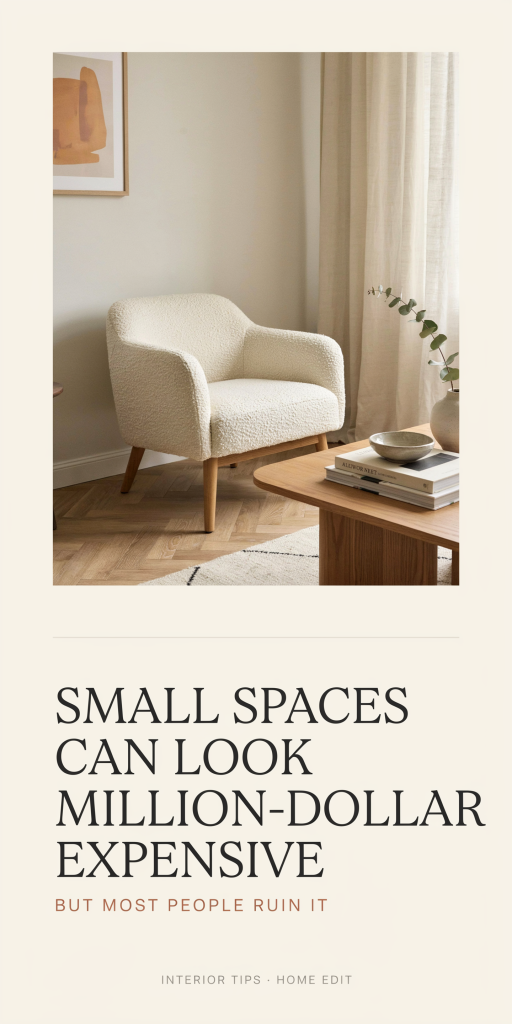
Furniture with clean lines and minimal ornament tends to read more refined. We favor pieces with a little heft, slim metal legs combined with solid upholstery, or wood with real grain, over flimsier, lightweight constructions that betray low cost.
Styling is about restraint and repetition. Repeat a material or color in two to three places (a brass lamp echoed by brass hardware, or the same blue hue in a cushion and a book cover). Use trays, stacks of books, and one or two sculptural objects to create layered vignettes. Resist the urge to display every decorative item you own: edit down and rotate seasonally.
Taken together, these principles produce cohesion. Cohesion is the secret of looking expensive: the room feels designed rather than accidental.
Budgeting And A Simple Makeover Plan For One Small Room
We’ll walk through a realistic, cost-conscious plan to elevate a single small room. We assume a modest budget, roughly $800–$1,500, and prioritize high-impact changes. You can scale up or down, but these moves deliver the most perceived value per dollar.
Phase 1, Edit & Clean (Free–$50, 1–2 days)
- Declutter ruthlessly: remove items that don’t serve the room’s new purpose.
- Deep clean surfaces, windows, and floors. Clean looks expensive.
- Rehang art and mirrors at eye level to create balanced sightlines.
Why it matters: Editing immediately clarifies the room’s architecture and focal points.
Phase 2, Paint & Small Fixes ($150–$400, 1–2 days)
- Repaint walls or trim in a cohesive palette. Choose a high-quality paint in eggshell for walls and satin for trim. A single accent wall in a deep, muted color can add drama.
- Replace visible hardware: doorknobs, outlet covers, switch plates, and cabinet pulls with coordinated finishes (brass, matte black, or satin nickel).
Why it matters: Color and small hardware upgrades lift the room’s baseline quality.
Phase 3, Lighting Upgrade ($150–$350, 1–3 days)
- Install a statement overhead fixture or pendant appropriate for the scale. Add dimmers where possible.
- Add one or two task/ambient lamps with warm bulbs (2700–3000K).
Why it matters: Lighting changes mood instantly and highlights textiles and finishes.
Phase 4, Key Furniture & Textiles ($300–$600, 1 week)
- Replace or reupholster one primary piece (e.g., an inexpensive sofa recovered in a neutral performance fabric) or add a great accent chair.
- Invest in a mid-sized rug to anchor the seating area, natural fibers like wool or a wool blend read higher-end.
- Add layered textiles: a throw, two quality cushions, and a set of tailored curtains hung high and wide to make the ceiling feel taller.
Why it matters: Textiles and one thoughtful furniture piece change perceived comfort and value.
Phase 5, Styling & Finishing Touches ($50–$150, 1–2 days)
- Add a large mirror to reflect light and enlarge the perceived volume.
- Style a vignette: tray, a couple of curated books, one sculptural object, and a plant.
- Finish with a small bouquet or a simple ceramic vase to introduce natural form.
Why it matters: Styling gives personality and completes the narrative.
Sample Budget Breakdown (mid-range):
- Paint and supplies: $200
- Hardware and fixtures: $100
- Lighting (fixture + bulbs + dimmer): $300
- Rug and textiles: $400
- Accent chair or reupholster: $400
- Styling items and plants: $100
Total: $1,500
Execution tips we’ve learned:
- Prioritize tactile upgrades that people touch: seating, handles, and textiles.
- Hang curtains so they start near the ceiling and extend beyond the window frame, this visually raises the room.
- Choose a restrained palette of two to three colors and a limited set of materials to maintain cohesion.
- Shop secondhand for larger items: refinishing or reupholstering a well-built piece often costs less than buying new and yields better quality.
Follow this plan and you’ll get a measurable transformation for a fraction of what a full renovation costs. The key is sequencing: clean and edit first, then add quality where it will be noticed most.
Conclusion
We don’t need a mansion to create a feeling of luxury. Small spaces reward careful decisions: proportion, materiality, and thoughtful lighting amplify perceived value more than price tags do. By editing possessions, upgrading tactile finishes, layering light, and styling with restraint, any tiny room can look intentionally expensive. Start small, focus spending where people touch and look, and you’ll be surprised how far modest investments will carry you.